additivetools

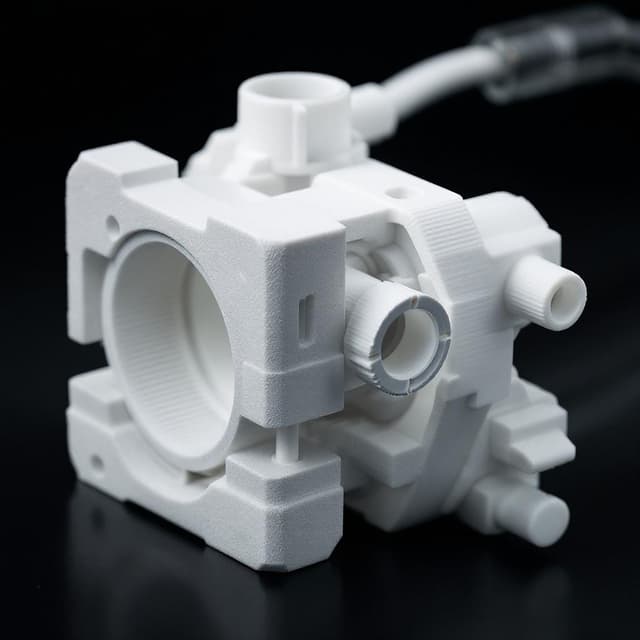
PA11 (Polyamide 11)

polymer

semi-crystalline thermoplastic polyamide (bio-based)

Nylon 11Rilsan PA11 (Arkema)EOS PA 1101Bio-based PA11Polyamide-11
Density
0.97 g/cm³
YS (SLS as-built (isotropic))
37–48 MPa
UTS (SLS as-built (isotropic))
40–50 MPa
Elongation (SLS as-built (isotropic))
25.0–55.0 %
Elastic modulus
1–2 GPa
Thermal conductivity
0.2 W/m·K
Glass transition (Tg)
42–50 °C

Mechanical & thermal properties — 1 condition

PropertySLS as-built (isotropic)
Elastic modulus1–2 GPa
Yield strength (0.2%)37–48 MPa
Ultimate tensile strength40–50 MPa
Elongation at break25.0–55.0 %
Density0.93–1.00 g/cm³
Thermal conductivity0.2 W/m·K
Glass transition (Tg)42–50 °C
As-built surface Ra10.0–20.0 µm

Values shown as min–max where a spread is reported, otherwise as typical ± unit. Ranges reflect inter-source variation, not single-sample scatter. All values are for AM-processed specimens unless noted.

Engineering considerations

  • Ductility advantage: if the application undergoes dynamic loading, repeated assembly/disassembly, or impact, PA11 is preferred over PA12. For static structural loading, PA12 is usually sufficient and cheaper.
  • Living hinge design: minimum hinge thickness 0.4 mm, minimum bend radius 0.8 mm for ≥10,000 flex cycles. Test at -20°C if cold-temperature flex is required — PA11 remains ductile at low temperature.
  • Powder parameters: PA11 requires sintering temperature ~2–3°C lower than PA12 on the same system. Build chamber temperature ~165–168°C vs PA12 ~170°C. Calibrate before running production PA11 builds.
  • Bio-claim: PA11 uses >80% bio-based carbon content (renewable castor oil feedstock). Suitable for companies under bio-preferred purchasing programmes (USDA BioPreferred etc.).
  • Inter-batch variability: stichel-2017-pa11 round-robin study showed 15–30% coefficient of variation (CV) for elongation across laboratories using nominally identical SLS processes. Test each production batch.
  • Post-processing: vapour smoothing works well for PA11. Dyeing achieves deeper colour penetration than PA12 in some formulations.
  • Thermal performance: PA11 HDT is similar to PA12 — both limited to ~60–80°C continuous service with load. For higher temperatures, switch to PEEK or high-performance PA (PA46, PPA).

Advantages

  • 2–3× higher elongation at break vs PA12 — key for applications requiring ductility or energy absorption
  • Bio-based monomer (castor oil feedstock) — lower lifecycle carbon footprint, supports bio-preferred procurement
  • Similar machine compatibility to PA12 — usable on most PA12-capable SLS systems after parameter adjustment
  • Excellent impact resistance and notch toughness — remains tough down to -40°C
  • Lower moisture absorption than PA6/PA66 — more dimensionally stable in varying humidity
  • Good chemical resistance (oils, greases, fuels, weak acids) — comparable to PA12
  • Good UV and ozone resistance for outdoor flexible components
  • Regulatory-compliant grades for food contact and medical applications

Limitations

  • Lower stiffness than PA12 — not suitable where high rigidity is needed
  • Higher sintering temperature window requires careful thermal calibration — not all PA12 SLS systems have qualified PA11 parameters
  • More limited availability of SLS machine parameters from OEMs vs PA12 — narrower ecosystem
  • Powder aging degradation similar to PA12 — rigorous refresh-ratio control required
  • Limited machine compatibility vs PA12 — verify with machine OEM before specifying
  • Higher raw material cost than PA12 (~20–40% premium) due to bio-based process
  • Less published AM data than PA12 — design allowables require more in-house testing

Typical applications

Flexible air ducts and tubing with high flex-cycle requirementsSports equipment: football boots, cycling shoes, customised orthotic insolesLiving hinges and snap-fit assemblies requiring multiple opening cyclesImpact-resistant enclosures and housingsOil & gas flexible pipe liners and sealing componentsAutomotive interior flexible clips and grommetsMedical consumables (non-implantable): catheter components, sampling devicesBio-preferred procurement: sustainability-mandated industrial partsRobotics flexible actuator components

Industries

automotiveindustrialconsumer

Standards & certifications

ASTM-E8established

Tensile property reference (polymer labs typically use ASTM D638 Type I specimens)

automotiveindustrialconsumer
ISO-52904established

Process quality assurance for safety-critical PBF parts

aerospacemedical

Compatible AM processes (1)

Other polymer materials

Related calculators

Last reviewed: 2026-05-04 · v1 · Sources: eos-pa1101-2023, arkema-pa11-2023, stichel-2017-pa11, zarringhalam-2006-pa12, debroy-2018-review