Digital Light Processing
DLPDLP-SLAProjector-based SLAVPP-DLPDigital Light SynthesisUV projector using a Digital Micromirror Device (DMD) chip, typically at 385–405 nm wavelength. Each build layer is exposed as a complete bitmap image in a single flash; individual DMD mirrors (pixels) are toggled on/off to define the cure pattern. Typical irradiance at the vat window: 5–50 mW/cm². Some high-speed systems increase irradiance to >100 mW/cm² to shorten exposure times per layer. LED or UHP lamp light sources are used; LED sources offer better spectral control and longer service life.
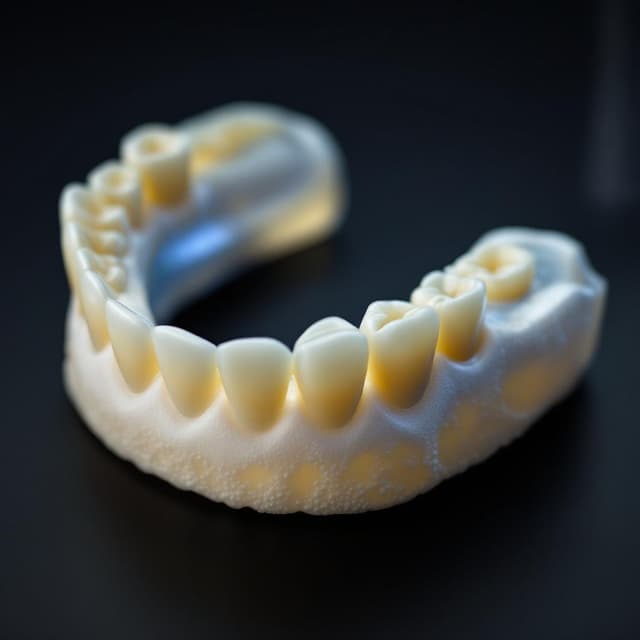
How it works
A photopolymer resin (typically acrylate or epoxy-acrylate, with a photoinitiator matched to 385–405 nm) fills a transparent-bottomed vat. In bottom-up DLP — the dominant industrial configuration — the build platform is submerged just above the vat floor (FEP film or PDMS window), and the projector illuminates upward through the window to cure a layer against the platform. After each layer cures, the platform lifts to peel the cured layer from the window (or the vat tilts/slides to reduce peel force), fresh resin floods beneath the part, and the next layer is exposed. The simultaneous whole-layer exposure makes cycle time per layer approximately constant regardless of cross-section geometry, making DLP significantly faster than SLA for parts with large cross-sections. Cure depth is governed by the resin's critical energy (Ec) and depth of penetration (Dp) per the Jacobs cure equation: Cd = Dp · ln(Emax/Ec). Layer thickness is set to be less than Cd to ensure interlayer bonding but limited to maintain Z resolution. After printing, parts require post-cure under broad-spectrum UV to drive conversion above ~90% and stabilise mechanical properties. Support structures are required for most overhanging geometry; these are typically generated automatically by slicing software and are removed manually after printing.
Defect modes (5)
Pixel Aliasing / Stairstepping on Curved Surfaces
Cause
The DMD chip projects a rectangular pixel grid at fixed native resolution. Curved or diagonal surfaces in XY are approximated by a staircase of square pixels at the pixel pitch (~50–150 µm for most commercial DLP systems). This is analogous to Z-direction stairstepping from layer discretisation, but manifests in the XY plane on surfaces not aligned to the pixel grid. Anti-aliasing (grayscale pixel rendering at boundaries) can reduce but not eliminate this artefact.
Indicator
Visible faceting or pixelation on cylindrical, spherical, or organic surfaces when inspected under magnification or raking light. Surface roughness Ra is higher on curved surfaces than on flat surfaces aligned with the pixel grid. Circular cross-sections appear polygonal at fine scale.
Prevention
Use a DLP system with the smallest available pixel size for the required build volume (smaller pixel pitch reduces aliasing). Enable anti-aliasing in the slicer if available. Orient critical curved surfaces so they are not parallel to the build platform — inclined surfaces exhibit more consistent aliasing that can be predicted and accounted for. Post-process with light sanding (800–1200 grit) or media blasting to smooth pixel steps.
Detection
- Visual inspection under raking light
- Optical profilometry (Ra, Rz measurement)
- 3D scanning and comparison to nominal CAD
FEP Window Delamination (Suction Cupping)
Cause
In bottom-up DLP, large flat cross-sections bond strongly to the FEP or PDMS release window during cure. The suction force required to separate the freshly cured layer from the window scales with the cross-sectional area and can exceed the interlayer bond strength of the resin — particularly for brittle resins or thin layers. Large solid cross-sections, dense infill, and slow peel speeds all increase delamination risk.
Indicator
Partial or complete layer delamination visible as missing geometry, cracks parallel to layer boundaries, or catastrophic build failure mid-print. The part detaches from the build platform and remains adhered to the FEP window. Audible cracking sound during peel step.
Prevention
Use hollow or latticed cross-sections with drain holes to break suction. Orient parts to minimise peak cross-sectional area per layer. Configure tilt/slide separation mechanisms (vs. straight pull) to reduce peel force by shear rather than tension. Use low-force FEP films or lubricated PDMS surfaces. Reduce exposure time on large cross-sections to limit cure depth into the window interface. Add anti-suction supports (small contact-point pillars) under large flat down-facing features.
Detection
- Visual inspection during and after build
- Layer-by-layer build monitoring (camera-based)
- Dimensional inspection of finished part
Resin Swelling and Bulk Dimensional Distortion
Cause
Photopolymer resins undergo volumetric shrinkage (typically 2–8%) during radical polymerisation as monomer chains cross-link and pack more densely. In thick sections or regions cured sequentially, differential shrinkage between already-cured and newly cured material generates residual stress. Some acrylate resins also exhibit osmotic swelling when exposed to isopropanol during post-print washing, temporarily distorting dimensions before the solvent evaporates. Large flat panels and thin cantilevers are most susceptible to curl and warp.
Indicator
Parts curve or warp away from intended flat surfaces after removal from build platform. Dimensional deviation concentrated at the base layers (first layers adhere most strongly and cannot relax). Temporary dimensional shift observed before and after IPA wash that resolves on drying.
Prevention
Select low-shrinkage resins (epoxy-acrylate or ceramic-filled resins typically shrink less than pure acrylate). Use post-cure under constrained fixturing for flat panels. Minimise IPA wash soak time; use agitated rinse rather than long immersion. Apply shrinkage compensation scaling factors in XY (typically 0.2–0.5% expansion applied in slicer) when tolerance requirements are tight.
Detection
- CMM or caliper measurement pre- and post-wash
- 3D scanning and nominal comparison
- Flatness measurement on reference surfaces
Incomplete Interlayer Bonding (Z-Delamination)
Cause
Each cured layer bonds to the layer below through photopolymerisation of residual unreacted monomer at the interface. If exposure energy is insufficient to drive cross-linking across the interface (too little Cd relative to layer thickness), or if the layer surface is contaminated or over-aged, the interlayer bond is weaker than the bulk. This is exacerbated by high-viscosity or pigmented resins that limit photoinitiator penetration. The cure depth equation (Jacobs equation) must be satisfied: Cd must exceed layer thickness to ensure interpenetration and bonding.
Indicator
Delamination fracture surfaces that are flat and parallel to the build direction. Lower Z-tensile or flexural strength compared to XY. Delamination visible as white or hazy horizontal planes in transparent resin parts. Brittle fracture initiating at layer boundaries under impact.
Prevention
Calibrate exposure settings to ensure cure depth exceeds layer thickness by 25–50% (overcure margin). Do not reduce exposure time below the resin's validated minimum. Ensure resin is well-mixed and at operating temperature (cold resin increases viscosity and slows penetration). Avoid excessive layer thickness (>100 µm) with highly pigmented resins that have short Dp. Post-cure UV step drives additional cross-linking across boundaries.
Detection
- Z-direction tensile testing
- Cross-section optical microscopy
- Impact testing (Charpy/Izod) in Z orientation
Light Bleed / Blooming
Cause
UV light from the projector scatters within the resin via Rayleigh and Mie scattering from resin particles, pigments, or fillers before it is absorbed by the photoinitiator. This scatter causes curing to extend laterally beyond the intended pixel boundary (blooming), reducing achievable feature sharpness and minimum feature size below the theoretical pixel pitch. Resins with low optical penetration depth (high absorber or pigment loading) reduce vertical blooming but cannot eliminate lateral scatter. Scatter is worse at lower irradiance levels that require longer exposures.
Indicator
Features are over-sized relative to CAD in XY — small holes are undersized or filled; thin walls are thicker than nominal. Adjacent features intended to be separated are fused. In transparent resins, observable as a diffuse halo around sharp features during exposure.
Prevention
Use resins formulated with reactive diluents or UV absorbers (e.g. Tinuvin-based additives) that limit scatter depth. Apply XY exposure offset (negative XY compensation in slicer) to compensate systematic bloom — measure a calibration coupon and dial in the offset value. Ensure projector lens focus is optimised for the vat working distance. Prefer shorter exposure times at higher irradiance to limit total scatter dose.
Detection
- Dimensional measurement of calibration coupons with known features
- Optical microscopy of fine features
- 3D scan comparison to CAD on small features