Fused Deposition Modelling
FFFFDMMEXFLMMaterial Extrusion AMResistive heating element in a hot-end nozzle (typically 180–500°C depending on material). No beam or radiation. Heat is applied locally to melt the filament at the nozzle tip. Some systems also heat the build chamber (60–250°C) to control thermal gradients and residual stress.
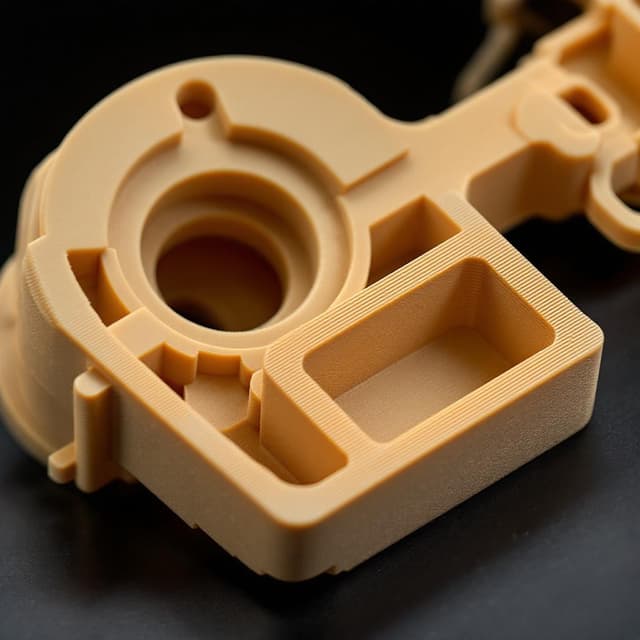
How it works
A thermoplastic filament (1.75 mm or 2.85 mm diameter) is fed into a heated nozzle, melted, and extruded through a small-diameter tip (typically 0.25–0.8 mm) onto a build platform or previously deposited material. The extruded bead bonds to adjacent beads and the underlying layer by thermal fusion and partial interdiffusion. The nozzle traces the XY cross-section of each layer; then the platform or nozzle moves in Z by one layer increment. Support structures are required for overhangs greater than ~45° — these are built simultaneously from a support material (soluble or breakaway) and removed after printing. Interlayer bonds form through polymer chain diffusion across the interface; this diffusion is limited by the cooling time and melt temperature, creating the characteristic Z-direction weakness.
Parameter envelopes (2 material–machine combinations)
Power
50–200 W (typ. 120 W)
Scan speed
50–250 mm/s
Layer thickness
127–254 µm
Preheat
120 °C
High-temperature FDM for PEEK: nozzle at 390–420°C, build chamber at 120°C (vs ~80°C for standard FDM). Soluble support material required (breakaway tends to damage PEEK parts). XY properties ~90–110 MPa UTS; Z direction ~50–65 MPa. Enclosed heated chamber mandatory — open-frame printers cannot process PEEK.
Scan speed
50–200 mm/s
Layer thickness
127–330 µm
Preheat
70 °C
FDM PA12 (nylon 12) extrusion: nozzle 280–310°C. Hygroscopic — filament must be dried before printing (4h at 70°C). FDM PA12 is not comparable to SLS PA12: FDM parts are ~40–60% weaker, anisotropic, and have layer-visible surfaces without post-processing.
Defect modes (4)
Interlayer Delamination (Z-Weakness)
Cause
Incomplete polymer chain interdiffusion across layer interfaces due to rapid cooling. The bond between layers is formed by weak physical adhesion rather than full molecular entanglement. Z-direction fracture strength is 30–60% lower than XY for most engineering thermoplastics.
Indicator
Failure plane is flat and parallel to build layers. Failure occurs at lower load than expected from XY tensile data. Visible layer lines in fractography. Particularly pronounced in PEEK and filled materials.
Prevention
Maximise printing temperature (within material limits) and minimise cooling time between layers. Use slow build speeds and large layer heights to increase thermal dwell time. Reduce layer height to increase weld bead contact area (lower Z, more Z moves). Optimise raster angle (±45° is typically best for tensile; 0° for flexure).
Detection
- Z-direction tensile testing
- fractographic analysis
- cross-section optical microscopy
Void Formation at Raster Gaps
Cause
Adjacent extrusion beads do not fully coalesce — a triangular void forms at the intersection of three beads. Infill percentage, raster angle, and extrusion width determine void fraction. At 100% infill the void fraction is still typically 2–8% for standard FDM.
Indicator
Internal porosity visible in cross-section. Reduced tensile strength and stiffness vs. theoretical fully-dense polymer. Higher water absorption through pore network.
Prevention
Use higher infill percentage (100% for structural). Increase extrusion multiplier to squeeze beads closer. Use contour + solid infill strategy. Anneal at 80% of Tg to allow partial void closure by viscous flow.
Detection
- Cross-section optical or SEM
- density measurement
- X-ray CT
Moisture-Induced Filament Degradation
Cause
Hygroscopic filaments (PA12, PA11, PEEK) absorb moisture during storage or handling. During printing, absorbed moisture vaporises in the nozzle, causing stringing, poor surface quality, and reduced mechanical properties from hydrolytic chain scission.
Indicator
Audible popping from nozzle during extrusion. Stringing and inconsistent bead diameter. Surface blistering or micro-voids in deposited material. Reduced tensile elongation in printed parts.
Prevention
Dry filament before printing: PA12 4h at 70°C, PEEK 4h at 130°C. Use desiccant dry-boxes during printing. Store unused filament in sealed bags with desiccant. Check filament moisture content with Karl Fischer titration for critical applications.
Detection
- Visual/audible during printing
- tensile test after printing
- weight loss measurement before/after drying
Support Interface Witness Marks
Cause
Support structures contact the part surface; when removed, they leave witness marks (rough surface, possible geometric distortion). Breakaway supports leave coarser marks than soluble (e.g., SR-30 or water-soluble PVA) supports.
Indicator
Ra >15 µm on support-contact surfaces after removal. Possible micro-damage or geometric distortion at support interface. Visible surface texture difference between supported and unsupported regions.
Prevention
Use soluble supports for critical surfaces. Minimise support contact area with appropriate support interface settings (Z-gap, sparse infill). Design parts to minimise support-contacting surfaces — orient critical surfaces upward (up-skin) rather than downward (down-skin).
Detection
- Visual inspection
- profilometry