Electron Beam Melting
EBMArcam EBMPBF-EB/MElectron Beam PBFe-PBFElectron beam generated by a tungsten filament cathode, accelerated at 60 kV. Beam deflection by electromagnetic coils — no moving optics. Beam current 1–50 mA; effective power up to 3000 W. Deflection speed up to 8000 m/s (no inertia: electromagnetically steered). Requires hard vacuum (<5 × 10⁻³ mbar) to prevent electron scattering.
How it works
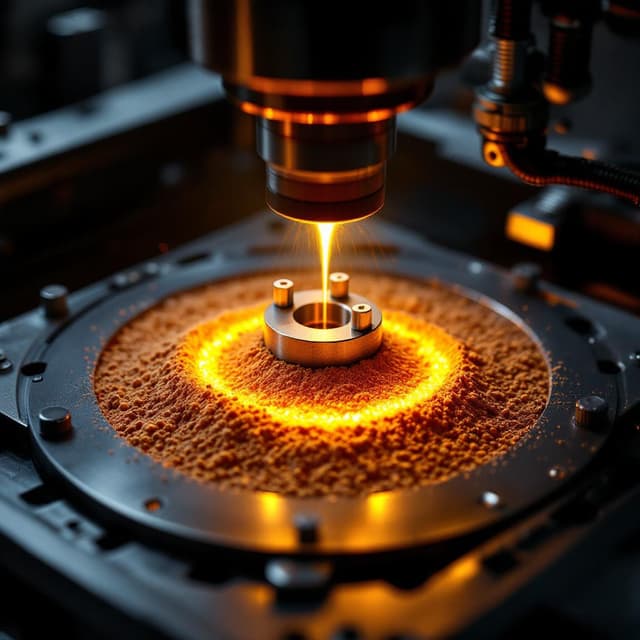
A powder bed of pre-alloyed metal powder (typically 45–106 µm, coarser than LPBF) is spread in layers and preheated to 700–1000°C by rapid rastering of the electron beam across the entire powder surface. This high preheat sinters the powder into a semi-coherent cake that supports the part (no support structures required for most geometries) and eliminates residual stress. The beam then selectively melts the powder at the part cross-section. Because the entire powder bed is hot, the solidification rate is slow (~10² K/s) compared to LPBF, producing coarser, more equiaxed microstructures with near-isotropic properties. Parts are removed from the powder cake by sandblasting. All processing occurs in a hard vacuum, eliminating oxidation and nitrogen pick-up.
Parameter envelopes (2 material–machine combinations)
Power
1000–3000 W (typ. 2000 W)
Scan speed
5000–8000 mm/s
Layer thickness
50–90 µm
Hatch spacing
100–200 µm
Max O₂
10 ppm
Preheat
730 °C
VED optimal
40–60 J/mm³
Arcam Spectra L (350 × 430 mm² build area). Preheat 730°C for Ti-6Al-4V. Very high scan speed enabled by electromagnetic deflection. Parts are near-stress-free — stress relief heat treatment is not required for Ti-6Al-4V EBM.
Power
1500–3000 W (typ. 2200 W)
Scan speed
5000–8000 mm/s
Layer thickness
50–100 µm
Hatch spacing
100–200 µm
Max O₂
10 ppm
Preheat
950 °C
Arcam Spectra H (high-temperature build chamber for alloys requiring >800°C preheat). CoCrMo EBM produces equiaxed microstructure with lower residual stress than LPBF. Typically used for dental and orthopaedic components.
Defect modes (4)
Powder Swelling / Smoke
Cause
Electron beam charges powder particles to the same sign, causing electrostatic repulsion between particles. If preheat is insufficient to sinter the powder surface before full melting beam exposure, particles repel violently — a phenomenon called 'smoke' that can contaminate the build chamber.
Indicator
Sudden loss of build pressure (vacuum spike). Visual smoke plume visible through viewport. Build stops automatically on modern Arcam systems when smoke is detected.
Prevention
Apply the correct preheat dose before melting: minimum 3–5 passes of the preheat beam at low power to sinter particles. Use the Arcam beam healing strategy after any smoke event. Increase ambient powder temperature before restarting.
Detection
- In-chamber pressure sensor (vacuum spike)
- machine control system (automatic abort)
- post-build visual inspection
Porosity from Powder Entrapment
Cause
Coarser EBM powder particles can bridge across features, trapping unmelted powder inside closed internal channels or lattice cells. Unlike LPBF, EBM powder sintering makes internal powder harder to remove.
Indicator
X-ray CT shows unmelted powder inside closed volumes. Heavy parts (density higher than expected from CAD volume).
Prevention
Design all internal channels with access holes for powder extraction. Minimum channel diameter for powder removal: 2–3× maximum particle D90. Use dedicated blowout nozzles during the post-build powder removal step.
Detection
- X-ray CT
- weight measurement vs. expected density
- visual inspection of cut cross-sections
Rough Surface Finish
Cause
Coarser powder particle size (45–106 µm vs. 10–45 µm for LPBF) and the partial sintering of surrounding powder to part surfaces produces inherently rougher surfaces than LPBF (Ra 25–60 µm vs. 5–20 µm).
Indicator
Ra > 25 µm as-built on all surfaces. Particularly rough on down-facing surfaces due to partial sintering of the underlying powder cake.
Prevention
Cannot be fully avoided — inherent to the process. Post-process: abrasive flow machining (AFM), HIP (closes surface pores), CNC machining of critical surfaces. EBM surface finish is acceptable for bone in-growth surfaces on orthopaedic implants.
Detection
- Contact profilometry
- non-contact white light interferometry
Columnar Grain Texture
Cause
Despite the high preheat (700–1000°C), directional heat extraction along the build direction still promotes some degree of columnar grain growth in EBM Ti-6Al-4V. Less severe than LPBF due to slower cooling rate and powder preheating.
Indicator
EBSD maps show some <001> texture in Z-direction, though weaker than LPBF. Mechanical anisotropy: Z-direction properties slightly lower than XY, but gap is typically smaller than in LPBF.
Prevention
HIP post-processing further homogenises microstructure and reduces anisotropy. Scan strategy optimisation can modify texture. For TiAl: columnar γ-TiAl grains with lamellar microstructure require specific scan strategies.
Detection
- EBSD
- optical metallography
- dual-axis tensile testing