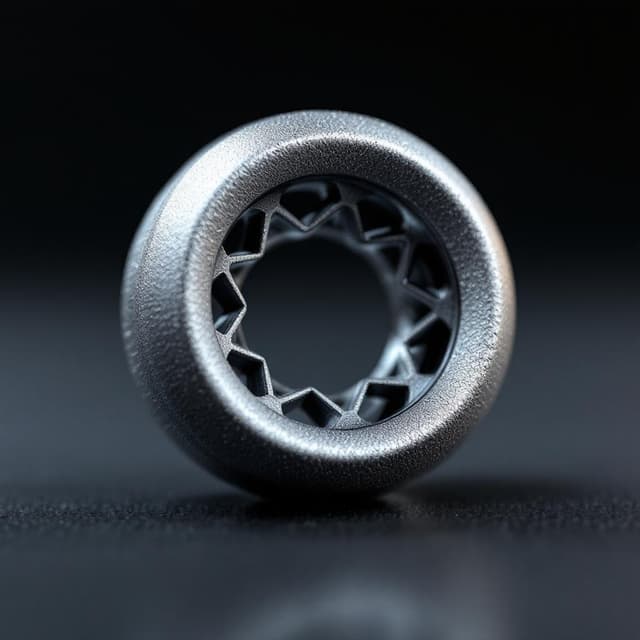
Ti-6Al-4V Grade 5
metaltitanium alloy — alpha-beta
Composition — UNS R56400 / ASTM F2924-14
| Element | Min % | Max % | Notes |
|---|---|---|---|
| Ti | bal. | balance | |
| Al | 5.50 | 6.750 | |
| V | 3.50 | 4.500 | |
| Fe | — | 0.300 | |
| O | — | 0.200 | Key interstitial — strength increases with O content but ductility decreases |
| N | — | 0.050 | |
| C | — | 0.080 | |
| H | — | 0.015 | Hydrogen embrittlement risk; controlled atmosphere mandatory during LPBF |
| Y | — | 0.005 |
Mechanical & thermal properties — 6 conditions
| Property | LPBF as-built (XY) | LPBF as-built (Z) | LPBF stress-relieved (600–650°C / 2–4h / Ar) | LPBF annealed (730–800°C / 2h / furnace cool) | LPBF + HIP (920°C / 100 MPa / 2h) | EBM as-built |
|---|---|---|---|---|---|---|
| Elastic modulus | 105–120 GPa | — | — | 110–118 GPa | — | 110–120 GPa |
| Yield strength (0.2%) | 990–1180 MPa | 940–1120 MPa | 950–1100 MPa | 825–1050 MPa | 830–970 MPa | 820–970 MPa |
| Ultimate tensile strength | 1150–1400 MPa | 1060–1280 MPa | 1050–1230 MPa | 895–1150 MPa | 895–1060 MPa | 895–1050 MPa |
| Elongation at break | 4.0–10.0 % | 3.0–8.0 % | 5.0–12.0 % | 8.0–14.0 % | 12.0–20.0 % | 10.0–18.0 % |
| Hardness (HV) | 350–430 HV10 | — | — | 310–370 HV10 | — | 300–360 HV10 |
| Fatigue strength | — | — | — | 450–650 MPa | 600–800 MPa | — |
| Fracture toughness KIC | — | — | — | — | 60.0–90.0 MPa√m | — |
| Density | 4.43 g/cm³ | — | — | — | — | — |
| Relative density | 99.0–100.0 % | — | — | — | 100.0 % | — |
| Thermal conductivity | 6.0–7.5 W/m·K | — | — | — | — | — |
| CTE | 8.4–9.0 µm/m·K | — | — | — | — | — |
| As-built surface Ra | 8.0–20.0 µm | — | — | — | — | 20.0–40.0 µm |
Values shown as min–max where a spread is reported, otherwise as typical ± unit. Ranges reflect inter-source variation, not single-sample scatter. All values are for AM-processed specimens unless noted.
Engineering considerations
- Always specify post-condition when referencing mechanical properties — as-built, stress-relieved, annealed, and HIP give very different results
- As-built elongation is typically insufficient for most aerospace specifications — plan for post-HT in the design phase
- For fatigue-critical applications: HIP + machined surfaces is minimum; polished surfaces preferred
- Support removal is challenging — internal supports are often impossible to remove; design to minimise internal supports
- Minimum wall thickness: ~0.3 mm achievable but <0.5 mm walls risk distortion and incomplete fusion
- Residual stress causes distortion on removal from build plate — substrate preheat (150–200°C) and scan strategy selection are key mitigations
- Powder reuse: ASTM F3049 powder characterisation required each lot; typically up to 30 reuse cycles before discard in aerospace
- Colour change from silver-grey to blue/gold on as-built surfaces indicates oxidation — check atmosphere seal integrity
- Electrochemical potential: Ti is noble (very low galvanic corrosion risk) but dissimilar metal contact with aluminium must be insulated
Advantages
- Exceptional specific strength — highest strength-to-density ratio of common AM metals
- Excellent corrosion resistance — passive TiO₂ film, highly resistant to seawater and body fluids
- Biocompatible — ISO 10993-1 and FDA cleared for implantable devices
- Well-characterised in AM — more published data and standards than any other AM metal
- Achieves wrought-equivalent fatigue life after HIP + machined surfaces
- LPBF as-built has no post-HT requirement for many structural (non-fatigue-critical) applications
Limitations
- High cost — raw powder 3–6× more expensive than stainless steel per kg
- Poor thermal conductivity (6–7 W/m·K) — limits heat dissipation applications
- Low hardness and wear resistance — unsuitable for tribological surfaces without coating
- As-built elongation typically 4–8% — may not meet ASTM F2924 ≥10% without annealing
- Sensitive to hydrogen embrittlement — strict atmosphere control required during LPBF (O₂ < 100 ppm, H₂ minimal)
- Difficult to machine after printing — low thermal conductivity causes tool wear; plan for machining allowances
- EBM powder not fully recyclable — particle sintering during build limits reuse ratio
- Flammable as fine powder — strict ATEX/OSHA powder handling protocols required
Typical applications
Industries
Standards & certifications
Ti-6Al-4V Grade 5 parts produced by powder bed fusion (LPBF and EBM)
Ti-6Al-4V ELI (Extra Low Interstitial) — lower O/N/Fe for fracture-critical and medical applications
ELI grade has lower interstitial content (O ≤ 0.13%, N ≤ 0.03%) vs. Grade 5. Use for implants and fracture-critical aerospace structures.
Ti-6Al-4V LPBF aerospace parts — stricter property minimums than ASTM F2924
Required by many Tier 1 aerospace OEMs. UTS minimum 930 MPa (vs. 895 MPa in F2924).
Process qualification for safety-critical metal PBF parts
Wrought Ti-6Al-4V — reference standard for implant property comparison
Wrought reference only. AM Ti-6Al-4V implants must additionally satisfy FDA AM Guidance 2017 or EU MDR Annex II.