additivetools

Inconel 718

metal

nickel superalloy — precipitation-hardened

UNS N07718Alloy 718IN718Nicrofer 5219Haynes 718Udimet 718AMS 5664 (wrought ref.)
Density
8.19 g/cm³
YS (LPBF as-built (XY))
650–920 MPa
UTS (LPBF as-built (XY))
880–1120 MPa
Elongation (LPBF as-built (XY))
10.0–30.0 %
Elastic modulus
185–210 GPa
Thermal conductivity
11.4 W/m·K

Composition — UNS N07718 / ASTM F3055-14

ElementMin %Max %Notes
Ni50.0055.000Base element. High Ni content drives creep resistance and oxidation protection
Cr17.0021.000Oxidation resistance via Cr₂O₃ scale; pitting and SCC resistance
Nb4.755.500Primary strengthener via γ'' (Ni₃Nb) precipitation; must stay in solution after anneal
Mo2.803.300Solid solution strengthening; creep resistance
Ti0.651.150Forms γ' (Ni₃Ti,Al) precipitates; controls γ'/γ'' ratio
Al0.200.800γ' former; oxidation resistance
Fe17.0019.000
Co1.000
C0.080
Mn0.350
Si0.350
P0.015
S0.015
B0.006Grain boundary strengthening — low B is critical to prevent hot cracking in LPBF
Cu0.300

Mechanical & thermal properties — 5 conditions

PropertyLPBF as-built (XY)LPBF as-built (Z)LPBF SA+DA (XY) — primary service conditionLPBF SA+DA (Z)LPBF + HIP + SA+DA (isotropic)
Elastic modulus185–210 GPa195–215 GPa
Yield strength (0.2%)650–920 MPa520–780 MPa1070–1180 MPa990–1110 MPa1050–1150 MPa
Ultimate tensile strength880–1120 MPa750–1000 MPa1310–1400 MPa1240–1360 MPa1270–1380 MPa
Elongation at break10.0–30.0 %8.0–28.0 %12.0–22.0 %10.0–19.0 %14.0–24.0 %
Hardness (HV)260–360 HV10400–460 HV10
Fatigue strength480–620 MPa580–720 MPa
Density8.19 g/cm³
Thermal conductivity11.4 W/m·K11.4 W/m·K
CTE12.5–13.5 µm/m·K

Values shown as min–max where a spread is reported, otherwise as typical ± unit. Ranges reflect inter-source variation, not single-sample scatter. All values are for AM-processed specimens unless noted.

Engineering considerations

  • Always specify SA+DA post-processing: solution anneal at 980°C (not 1065°C — avoids δ-phase dissolution zone) + 720°C/8h FC to 620°C/8h. The exact temperature and time must be controlled to ±10°C.
  • Laves phase verification: before shipping structural parts, verify Laves dissolution via SEM-EDS or hardness mapping. Residual Laves will appear as Nb/Mo-rich particles and corresponds to hardness excursions.
  • Stress relief is mandatory before part removal: minimum 1000°C/1–2h in vacuum or argon. Removal without stress-relief will cause significant distortion in large or complex parts.
  • Build orientation: for fatigue-critical applications, ensure primary load axis is in the XY plane in as-built condition. After SA+DA, anisotropy reduces but does not disappear — document orientation on traveller.
  • HIP requirement: for NADCAP-controlled flight-critical parts, HIP (1163°C/100 MPa/4h) before SA+DA is standard practice at most Tier 1 aerospace AM suppliers. Budget 40–60% cost premium over SA+DA alone.
  • Cracking risk: IN718 has lower hot-cracking susceptibility than many other Ni superalloys (no high Al+Ti) but liquation cracking at grain boundaries can occur with improper preheating or excessive energy density.
  • Surface finish: as-built Ra 10–20 µm is too rough for many hot-section applications. Electrochemical machining (ECM) or abrasive flow machining (AFM) used for internal channel smoothing — specify finish method in design.
  • Creep design: use the 100,000h larson-miller parameter data for wrought IN718 as a conservative baseline. LPBF SA+DA creep data is still sparse — avoid creep-critical applications without specific test data.
  • Repair: LPBF IN718 can be laser-cladded or TIG-welded with IN625 or IN718 filler — widely used for cast/forged IN718 engine part repair. Process qualification required per OEM specifications.

Advantages

  • Highest retained strength of common AM metals at elevated temperature — YS remains >700 MPa at 650°C
  • Outstanding oxidation and hot corrosion resistance to 980°C
  • Well-characterised post-processing route (SA+DA) produces wrought-equivalent or better properties
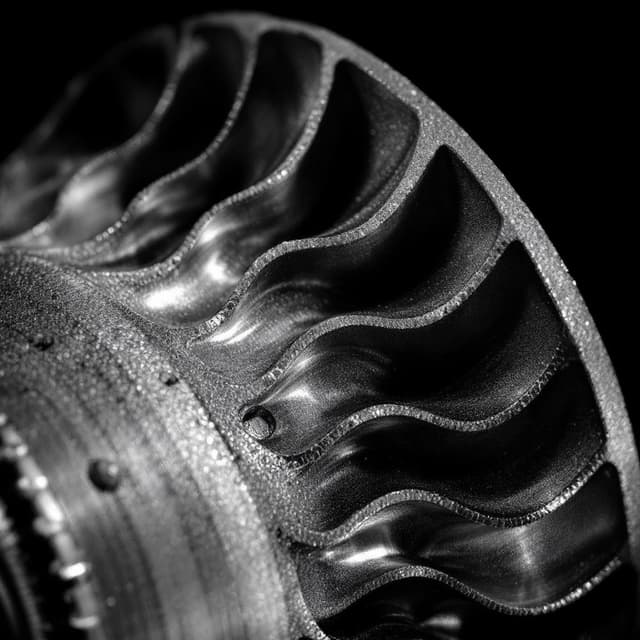
  • LPBF enables complex internal cooling channels impossible in forging — critical for turbine thermal management
  • Wide LPBF process window — relatively low crack susceptibility vs IN625, IN939, or CM247LC
  • Comprehensive standards ecosystem: ASTM F3055, AMS 7009, NADCAP — clear qualification path
  • Good weldability (low B, controlled S) — allows hybrid LPBF + TIG repair strategies
  • Magnetic permeability of ~1.01 — effectively non-magnetic for sensor-critical applications

Limitations

  • SA+DA heat treatment is mandatory for structural use — as-built properties are unacceptable for high-temperature service
  • Laves phase formation during LPBF is intrinsic — Nb segregation cannot be fully prevented; only dissolved in post-processing
  • Residual stress is extremely high in as-built LPBF IN718 — stress-relieve before removal from build plate or part will distort
  • Very low thermal conductivity (11 W/m·K) — highest residual stress and cracking risk of the common LPBF metals
  • Powder cost is 3–5× that of 316L stainless — cost-justify with functional requirement, not just temperature tolerance
  • LPBF IN718 has lower oxidation resistance above 980°C than cast/wrought — chromia scale is not stable at higher temperatures
  • High γ'' precipitation kinetics during LPBF cooling may lead to over-aging in slow-cooling regions — parameter uniformity critical
  • Powder reactivity with moisture and oxygen — strict storage protocol; atmospheric control during process and powder handling mandatory

Typical applications

Turbine engine combustion chambers and linersTurbine blades and vanes (stationary airfoils)Fuel nozzles and injectorsExhaust housings and manifoldsRocket propulsion injectors and chambersOil & gas downhole tools and wellhead componentsCryogenic turbopump componentsStructural engine brackets and mountsHeat exchangers for high-temperature processesNuclear fasteners and pressure-boundary hardware

Industries

aerospacedefenceenergyindustrial

Standards & certifications

ASTM-F3055established

IN718 (UNS N07718) parts produced by powder bed fusion — composition, powder, and minimum mechanical property requirements

aerospacedefenceenergyindustrial
AMS-7009established

IN718 LPBF for aerospace structural applications — solution-annealed + double-aged (SA+DA) condition requirements

aerospacedefence

Required by most Tier 1 aerospace OEMs for structural and engine-adjacent IN718 LPBF parts. Sets UTS ≥1310 MPa, YS ≥1070 MPa, El ≥12%.

AMS-7000established

LPBF process requirements — machine qualification, atmosphere, process controls for aerospace production

aerospacedefence
ASTM-E8established

Tensile test method for acceptance testing

aerospaceenergyindustrial
ASTM-E466established

Force-controlled fatigue testing — critical for engine and rotating applications

aerospaceenergy
NADCAP-AC7110-14established

Third-party accreditation for AM metallic parts — required by most prime aerospace contractors

aerospacedefence

NADCAP accreditation required before supplying flight-critical IN718 AM parts to Airbus, Boeing, GE Aviation, Pratt & Whitney, Rolls-Royce, and Safran.

Compatible AM processes (4)

Other metal materials

Related calculators

Last reviewed: 2026-05-04 · v1 · Sources: ASTM-F3055, AMS-7009, eos-in718-2023, jia-2014-in718, shipley-2018-in718-review, tucho-2017-in718, popovich-2017-in718, debroy-2018-review, yadollahi-2017-fatigue, ASTM-E8, ASTM-E466, NADCAP-AC7110-14