additivetools

Wire Arc Additive Manufacturing

WAAMDED-ArcDED-Wire/ArcGMAW-AMGTAW-AM

Electric arc (GMAW / GTAW / plasma) generating 3–10 kW of heat at the wire tip. Some systems use electron beam (EBAM) or laser (LMD-W). Wire feedstock 0.8–3.2 mm diameter. Arc current 50–300 A, voltage 15–40 V. Shielding gas (Ar, Ar+He, Ar+CO₂) protects the melt pool.
Layer thickness
1000–10000 µm
Tolerance
±0.5–2 mm
Surface Ra
50–200 µm
Build rate
300–6000 cm³/h
Relative density
99–100 %
Min wall
3 mm (typ. 6 mm)
Min feature
5 mm (typ. 10 mm)
Supports required
Yes

How it works

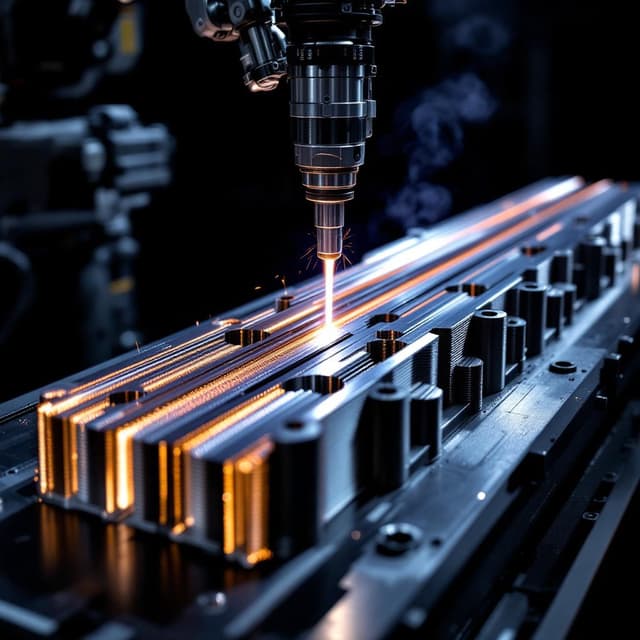
A wire electrode is fed into an electric arc between the torch and the substrate. The arc melts the wire tip and a region of the substrate/previous bead, creating a melt pool that solidifies as the torch traverses. Typical bead width is 5–15 mm, bead height 2–6 mm — orders of magnitude larger than LPBF. Parts are built bead-by-bead in pre-programmed tool paths derived from the CAD slicing. Between layers or beads, active cooling (forced air, water-cooled backing, cold spray) may be applied to control interpass temperature. WAAM is typically combined with an industrial robot or CNC gantry. Post-machining is almost always required (final tolerances ±0.5–2 mm as-deposited).

Parameter envelopes (2 material–machine combinations)

Ti-6Al-4V Grade 5argon

Power

15008000 W (typ. 4000 W)

Scan speed

315 mm/s

Layer thickness

10003000 µm

Max O₂

50 ppm

Ti-6Al-4V WAAM requires enclosed argon chamber or rigid trailing shield. Interpass temperature control (typically <150°C) is critical for microstructure. Annealing or HIP required post-build. Buy-to-fly improvement vs. machined billets: 5–20× material saving for complex aerospace parts.

316L Stainless Steelargon

Power

10005000 W (typ. 2500 W)

Scan speed

520 mm/s

Layer thickness

20005000 µm

Max O₂

500 ppm

316L WAAM uses standard GMAW or GTAW wire. Deposition rate 2–6 kg/h. Local Ar shielding usually sufficient. Residual stress management is the primary challenge for multi-metre structures.

Defect modes (3)

Residual Stress and Distortion

Cause

High heat input (~3–8 kW) concentrated in a small weld zone generates steep thermal gradients. Residual stresses accumulate over hundreds of layers, causing significant distortion — the dominant engineering challenge in WAAM. Thin walls and asymmetric geometries are most susceptible.

Indicator

Part lifts from build platform during build. CMM measurement after build shows >5 mm deviation from CAD. Cracking at stress concentrations on high-constraint geometries.

Prevention

Preheat substrate. Use symmetric deposition strategies (alternate side deposition). Apply inter-layer rolling or hammering (hybrid WAAM-peening systems). Use distortion compensation in CAD model (inverse of predicted bow). Fibre-optic strain monitoring during build.

Detection

  • CMM dimensional measurement
  • strain gauges during build
  • neutron diffraction (destructive — post-build sections)
  • Contour method

Coarse Columnar Grain Structure and Banding

Cause

Very slow cooling rates (~10¹–10² K/s) and large melt pools promote large columnar grains that can span 10+ deposited layers. Cyclic thermal reheating of previously deposited material produces banded microstructure with alternating coarse/fine zones.

Indicator

Macro-etching reveals bands of alternating grain size aligned with layer interfaces. EBSD shows strong <100> or <110> texture. Tensile anisotropy XY vs. Z >25%. Creep properties reduced in Z direction.

Prevention

Optimise interpass temperature (lower = finer grain, but slower build rate). Post-process: HIP + anneal or HIP + SA+DA for Ni alloys. Ultrasonic peening between passes to promote recrystallisation. Add grain refiners (Sc for Al alloys).

Detection

  • Macro-etching
  • EBSD
  • optical metallography
  • dual-axis tensile testing

Porosity from Shielding Gas Contamination

Cause

Sub-surface pores (spherical, 50–500 µm) caused by dissolved gas (H₂, N₂) in the wire feedstock or from shielding gas contamination reaching the melt pool. Hydrogen is the primary cause in aluminium WAAM; nitrogen in titanium if atmosphere is compromised.

Indicator

Spherical pores visible in X-ray CT or cross-section metallography. Density measurement lower than expected. Radiographic inspection shows scattered porosity.

Prevention

Use clean, dry wire feedstock stored in sealed spools. Monitor shielding gas purity and flow. Preheat wire with resistive heating immediately before the torch for hydrogen-sensitive alloys. Use vacuum EBAM for reactive materials.

Detection

  • X-ray radiography
  • X-ray CT
  • Archimedes density measurement

Compatible materials

Governing standards

Related calculators

Last reviewed: 2026-05-04 · v1 · Sources: debroy-2018-review, sames-2016-metallurgy