additivetools

316L Stainless Steel

metal

austenitic stainless steel

UNS S31603EN 1.4404DIN X2CrNiMo17-12-2AISI 316LSS 316L
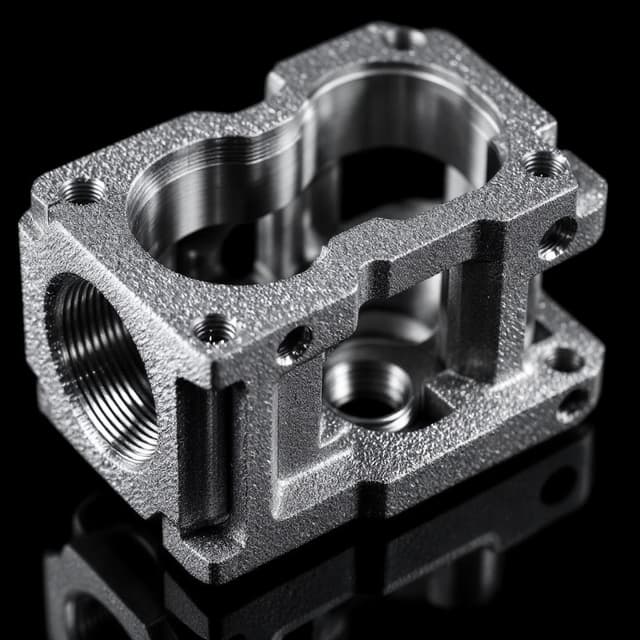
Density
7.99 g/cm³
YS (LPBF as-built (XY))
450–560 MPa
UTS (LPBF as-built (XY))
580–700 MPa
Elongation (LPBF as-built (XY))
30.0–55.0 %
Elastic modulus
193 GPa
Thermal conductivity
14.0 W/m·K

Composition — UNS S31603 / ASTM F3184-16

ElementMin %Max %Notes
Febal.balance
Cr16.0018.000
Ni10.0014.000
Mo2.003.000Key for pitting resistance — differentiates 316 from 304
Mn2.000
Si0.750
C0.030Low carbon ('L') reduces sensitisation risk during AM thermal cycles
P0.045
S0.030Lower S improves toughness and weldability
N0.100Nitrogen stabilises austenite; AM atmosphere control prevents N loss

Mechanical & thermal properties — 6 conditions

PropertyLPBF as-built (XY)LPBF as-built (Z)LPBF as-built, machined surface (XY)LPBF stress-relieved (XY)LPBF solution-annealed (XY)LPBF + HIP (isotropic)
Elastic modulus193 GPa
Yield strength (0.2%)450–560 MPa420–530 MPa440–540 MPa200–270 MPa190–250 MPa
Ultimate tensile strength580–700 MPa540–640 MPa560–660 MPa500–570 MPa490–560 MPa
Elongation at break30.0–55.0 %25.0–50.0 %32.0–55.0 %45.0–65.0 %50.0–70.0 %
Reduction in area65.0 %
Hardness (HV)200–260 HV10195–255 HV10190–250 HV10140–175 HV10135–170 HV10
Fatigue strength160–240 MPa250–330 MPa240–320 MPa
Density7.99 g/cm³
Thermal conductivity14.0 W/m·K
Specific heat500 J/(kg·K)
CTE16.5 µm/m·K

Values shown as min–max where a spread is reported, otherwise as typical ± unit. Ranges reflect inter-source variation, not single-sample scatter. All values are for AM-processed specimens unless noted.

Engineering considerations

  • Residual stress: 316L has high CTE (16.5 µm/m·K) and low thermal conductivity — large overhangs and solid blocks accumulate significant residual tensile stress. Use island scan strategy with interlayer rotation (e.g., 67°).
  • Anisotropy: 5–15% strength reduction in Z vs XY. For load-critical parts, orient the primary load axis in the XY plane.
  • Sensitisation risk is negligible in LPBF: low carbon content (≤0.03%) and rapid cooling prevent Cr₂₃C₆ precipitation at grain boundaries during AM thermal cycles.
  • HIP decision: for fatigue-critical parts, HIP at 1100°C / 100 MPa / 4h eliminates sub-surface porosity and substantially extends fatigue life. Expect 30–50% cost premium.
  • Post-processing sequence for corrosion-critical parts: LPBF → stress-relieve (650°C/1h) → rough machine → solution anneal (1050°C/30 min, water quench) → finish machine → electropolish.
  • Binder jetting note: BJ 316L requires sintering at ~1360°C with ~15–20% linear shrinkage. Final density 98–99.5% — acceptable for structural but not pressure-critical applications without additional qualification.
  • Electropolishing: removes 20–50 µm material; smooths Ra from ~10 µm to <0.5 µm. Essential for food-contact, pharmaceutical, and hygienic fluid applications.
  • Powder degradation: limit re-use to 20–30 cycles without blending into virgin powder. Monitor oxygen content — O > 0.10% signals degradation and elevated sensitisation risk.
  • Wall thickness: minimum printable wall ~0.3 mm; for structural load ≥0.8 mm recommended. Thin walls below 0.5 mm show higher porosity due to keyhole instability at edges.

Advantages

  • Excellent corrosion resistance across wide pH range — superior to 304 in chloride environments due to Mo content
  • As-built LPBF strength significantly exceeds wrought 316L minimum specifications
  • Fully austenitic — non-magnetic (critical for MRI-adjacent medical equipment and sensitive electronic environments)
  • Outstanding toughness at cryogenic temperatures down to -196°C (liquid nitrogen service)
  • Good biocompatibility — ISO 10993 compliant for surgical instruments and implant-adjacent structures
  • Well-established LPBF parameter sets available from all major machine OEMs — shortest time-to-print of any AM stainless
  • Cost-effective feedstock compared to titanium or nickel superalloys
  • Excellent powder flowability — high sphericity, minimal satellites, consistent layer spreading

Limitations

  • Annealing eliminates the AM strength advantage — post-HT strength approaches wrought levels; re-specifying to wrought may be more cost-effective
  • Susceptible to stress corrosion cracking (SCC) in hot (>60°C) concentrated chloride environments — use duplex 2205 or super-duplex for such media
  • Low thermal conductivity (14 W/m·K) causes high thermal gradients and residual stress — warpage risk on large flat sections without scan strategy optimisation
  • Not hardenable by heat treatment (austenitic) — for high-strength applications use maraging steel, 17-4PH, or Ti-6Al-4V
  • As-built surface roughness (Ra 10–20 µm) incompatible with hygienic applications without post-machining and electropolishing
  • Pitting corrosion resistance (PREN ~24) below super-duplex grades — review PREN = Cr + 3.3×Mo + 16×N against aggressive media
  • Powder re-use must be controlled — oxygen and nitrogen pickup with repeated cycling degrades corrosion resistance and ductility

Typical applications

Heat exchangers and manifolds with complex internal channelsImpellers and pump components (corrosion-resistant)Surgical instruments and medical device housingsStructural brackets, mounts, and housingsTooling and fixtures for corrosive environmentsChemical reactor internals and fluid handling hardwareCryogenic vessel components and cold-plate structuresNuclear handling and containment hardwareOffshore and subsea connectors (industrial / energy sector)Food-contact and pharmaceutical processing equipment (post-polished)

Industries

aerospacemedicalindustrialenergy

Standards & certifications

ASTM-F3184established

316L (UNS S31603) parts produced by powder bed fusion — composition, powder, and minimum mechanical property requirements

aerospacemedicalindustrialenergy
ISO-52904established

Process quality assurance framework for safety-critical metal PBF parts

aerospacemedicaldefence
ASTM-E8established

Tensile test method for acceptance testing of AM 316L

aerospacemedicalindustrial
ASTM-E466established

Force-controlled fatigue testing for rotating and cyclic applications

aerospaceindustrialenergy

Compatible AM processes (5)

Other metal materials

Related calculators

Last reviewed: 2026-05-04 · v1 · Sources: ASTM-F3184, eos-316l-2023, renishaw-316l-2023, liu-2017-316l, saeidi-2015-ultra, debroy-2018-review, herzog-2016-metals, yadollahi-2017-fatigue, ASTM-E8, ASTM-E466, ISO-52904