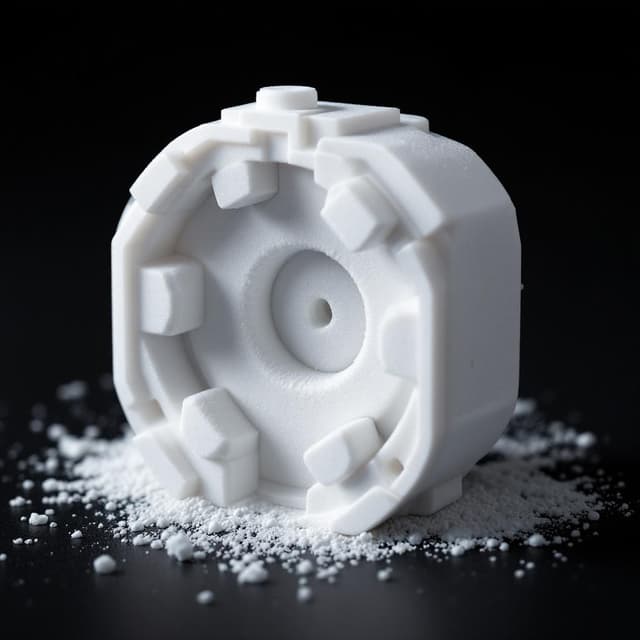
Nylon PA6 / PA66 (Polyamide 66)
polymersemi-crystalline engineering thermoplastic polyamide
Mechanical & thermal properties — 2 conditions
| Property | FDM as-built (XY, dry-as-printed) | FDM as-built (Z — upright, dry) |
|---|---|---|
| Elastic modulus | 2–3 GPa | — |
| Ultimate tensile strength | 62–82 MPa | 32–55 MPa |
| Elongation at break | 20.0–50.0 % | 8.0–25.0 % |
| Density | 1.12–1.16 g/cm³ | — |
| Glass transition (Tg) | 60–80 °C | — |
| As-built surface Ra | 10.0–24.0 µm | — |
Values shown as min–max where a spread is reported, otherwise as typical ± unit. Ranges reflect inter-source variation, not single-sample scatter. All values are for AM-processed specimens unless noted.
Engineering considerations
- Moisture content governs performance — design for wet condition: the most important engineering decision when specifying PA66 is identifying the in-service moisture state. If the part will reach 50% RH equilibrium (months in ambient indoor environment), use wet properties: E ≈ 1.8 GPa, UTS ≈ 55–60 MPa, HDT ≈ 130°C. The dry-as-printed properties are only valid for sealed or very short-duration applications.
- Drying protocol is mandatory, not optional: dry PA66 filament at 70–80°C for 12 hours minimum in a desiccant oven before every print. Print from a sealed dry-box with fresh desiccant. PA66 reabsorbs moisture from ambient air within 30–60 minutes at 50% RH — time from oven to printer must be minimised. For production environments, invest in a dry-box filament feeder.
- Print temperature optimisation: start at 260°C nozzle. If Z-direction delamination occurs, increase to 270°C. If surface roughness or stringing increases at 270°C, try 265°C. Chamber temperature 60°C is the recommended starting point — increase to 70°C if warping is observed. Bed temperature 80°C minimum.
- PA66 vs PA12 SLS comparison: for applications that can use SLS, PA12 SLS (isotropic, no moisture issues during printing, established process) is often preferable to PA66 FDM. PA66 FDM makes sense when: SLS is not available; FDM geometry/volume is acceptable; and the higher dry UTS (75 vs 48 MPa) is a design requirement.
- Dimensional accuracy and moisture expansion: PA66 parts change dimension with moisture absorption — parts printed dry will expand slightly as they absorb moisture in service. For precision components, condition to equilibrium moisture content before final dimensional inspection. Typical linear expansion: ~0.5–1.0% from dry to 50% RH equilibrium.
- Annealing improvement: annealing PA66 FDM parts at 150–160°C for 2–4 hours (in a sealed container to prevent oxidation) increases crystallinity by 5–10%, improving dry-condition stiffness and HDT while slightly reducing elongation. Not universally beneficial — evaluate on a part-by-part basis. Account for annealing shrinkage (~0.3–0.8%) in final dimensions.
- Chemical resistance advantage over ABS and PC: PA66 resists a wider range of chemicals than ABS or PC. Specific resistances: fuels (petrol, diesel, AVTUR) — excellent; motor oils and hydraulic fluids — excellent; dilute HCl and H₂SO4 — moderate; ketones (acetone, MEK) — poor; strong mineral acids and concentrated oxidising acids — poor. For chemical resistance in outdoor or industrial environments, PA66 often outperforms ABS, ASA, and PC.
Advantages
- Highest dry-condition mechanical performance of FDM polyamides: UTS 75 MPa (XY) — superior to PA12 SLS (48 MPa) and all common FDM engineering polymers except PC
- Excellent toughness: elongation 35% XY is high for an engineering FDM polymer — parts absorb impact energy without brittle fracture
- Superior chemical resistance: PA66 resists hydrocarbons (fuels, oils, greases), dilute acids, and most solvents significantly better than ABS, ASA, or PC
- Excellent abrasion resistance: PA66 sliding wear performance approaches PEEK for tribological applications (gears, cams, bushings)
- High dry HDT (200°C at 1.8 MPa): in dry environments or sealed conditions, PA66 outperforms all other common FDM polymers at elevated temperature
- Good dielectric properties: suitable for electrical insulation applications, connector housings, and cable management
- Self-lubricating: low coefficient of friction in dry sliding contact — useful for bearings, cams, and guide rails without external lubrication
Limitations
- CRITICAL — extremely hygroscopic: PA66 absorbs 8–9% water by weight at 50% RH equilibrium and up to 9.5% when fully immersed. This is 6× more than PA12 (1.5%) and dramatically more than ABS (<0.5%). Absorbed moisture acts as a plasticiser, reducing modulus from 2.8 GPa (dry) to 1.5–2.0 GPa (wet) and HDT from 200°C to 130°C
- MUST print with dried filament: PA66 filament must be dried at 70–80°C for a minimum of 12 hours before printing. Wet PA66 produces catastrophic layer delamination, voids, surface bubbling, and near-zero Z-direction strength. This is the single most critical processing requirement
- Wet properties govern service design: for any application where the part will be exposed to humidity (including ambient 40–60% RH over months), design using wet mechanical properties, not dry-as-printed values. The 200°C dry HDT is irrelevant if the part will absorb moisture in service
- Requires industrial FDM platform: consistent PA66 parts require active chamber heating (50–70°C) and a stiff, thermally stable machine. Desktop FDM printers without enclosures produce inconsistent PA66 results. Stratasys Fortus series and Markforged are the primary qualified platforms
- High print temperature (250–270°C): requires all-metal hotend on open-format printers. PTFE-lined hotends (standard Ender-type) are limited to 240°C and are not suitable. Hardened steel or ruby nozzle recommended to avoid rapid wear
- Significant warping: PA66 semi-crystalline shrinkage produces more warping than amorphous polymers (ABS, ASA, PC). Enclosure heating, high bed temperature (80–90°C), and wide brims are required for large parts
- Not suitable for sustained outdoor UV: PA66 has moderate UV resistance — better than PC without stabiliser but not as good as ASA. For outdoor UV applications, use ASA (for lower loads) or UV-stabilised PA12 (for SLS production parts)
- PA66 for SLS/PBF is uncommon: PA66 powder bed fusion is technically possible but commercially limited due to the narrow sintering window and high crystallisation temperature. EOS and Farsoon offer PA11 and PA12 for SLS but not mainstream PA66 powder — this entry covers FDM as the primary AM route for PA66
Typical applications
Industries
Standards & certifications
Tensile testing of plastics — applicable to FDM PA66 specimens
ISO 527-2 Type 1B specimens standard for FDM PA66 mechanical testing. Moisture conditioning state MUST be documented with all PA66 data — dry-as-printed, 23°C/50% RH equilibrium, and wet (immersed) are three distinct datasets. ISO 1110 conditioning protocol applies for equilibrium-moisture specimens.
Compatible AM processes (1)
Other polymer materials
Related calculators
Unlock the full property data — sign up free
Free account · no credit card · no marketing. Sign up to unlock the full library: 26 articles, 45 materials, 10 processes, 43 papers and more.