additivetools

ULTEM 1010 (Polyetherimide PEI)

polymer

amorphous high-performance thermoplastic (polyetherimide family)

SABIC ULTEM™ 1010PolyetherimidePEIUltem 1010 ResinStratasys ULTEM 1010
Density
1.27 g/cm³
YS (FDM as-printed (XY) — Stratasys Fortus)
65–83 MPa
UTS (FDM as-printed (XY) — Stratasys Fortus)
72–90 MPa
Elongation (FDM as-printed (XY) — Stratasys Fortus)
2.5–4.5 %
Elastic modulus
3–4 GPa
Thermal conductivity
0.2 W/m·K
Glass transition (Tg)
212–222 °C
Max service temp
160–180 °C

Mechanical & thermal properties — 2 conditions

PropertyFDM as-printed (XY) — Stratasys FortusFDM as-printed (Z) — Stratasys Fortus
Elastic modulus3–4 GPa
Yield strength (0.2%)65–83 MPa47–63 MPa
Ultimate tensile strength72–90 MPa55–72 MPa
Elongation at break2.5–4.5 %1.2–2.8 %
Density1.24–1.30 g/cm³
Thermal conductivity0.2 W/m·K
Glass transition (Tg)212–222 °C
Max service temperature160–180 °C

Values shown as min–max where a spread is reported, otherwise as typical ± unit. Ranges reflect inter-source variation, not single-sample scatter. All values are for AM-processed specimens unless noted.

Engineering considerations

  • Annealing note: ULTEM 1010 is amorphous and does NOT benefit from post-print annealing. Unlike PEEK or PEKK (semi-crystalline), there is no crystallinity to develop. Annealing above Tg (217°C) will cause deformation. Do not anneal.
  • Build orientation: orient the primary load axis in the XY plane. Z-direction UTS (63 MPa) is 22% below XY (81 MPa). For housings and enclosures, orient so that lid/base-opening flanges are in XY — these are typically the highest-stress interfaces.
  • Moisture management: despite low equilibrium moisture absorption (<0.25% by weight), ULTEM 1010 filament must be dried before printing (80°C/6h). Moisture causes surface bubbling, layer delamination, and reduced properties. Store in sealed canisters with desiccant.
  • Comparison with ULTEM 9085: ULTEM 9085 (used in aerospace cabin interiors) has FAR 25.853 FST certification and higher elongation (~3–4% XY) but lower HDT (~153°C). ULTEM 1010 has superior thermal performance and food/bio compliance. Select based on the primary regulatory requirement: FST → 9085; food/medical/thermal → 1010.
  • Autoclave tooling design: ULTEM 1010 tools are limited to ~180°C cure cycles (120°C epoxy out-of-autoclave or 177°C prepreg autoclave cycles are at the operating limit). For 180°C/7 bar autoclave cure cycles, verify creep compliance under combined temperature and pressure load with specific part geometry.
  • Food contact compliance: NSF 51 certification is process-specific to Stratasys Fortus systems. Verify current NSF certification status for the specific machine and ULTEM 1010 lot being used before claiming food-contact compliance. Customer requirements may also require 3-A Sanitary Standards compliance for direct food or beverage contact.
  • Support material: ULTEM 1010 requires SR-110 support material (also high-temperature) which dissolves in an EcoWorks bath. Support removal quality affects part dimensional accuracy and surface finish. Internal channels <3 mm diameter may be difficult to clear of support material.
  • Surface finish: FDM ULTEM 1010 as-printed Ra ~5–12 µm (depending on raster angle and layer thickness). Can be post-machined (carbide tooling), hand-sanded, or vapour smoothed (Stratasys RD1000 treatment) to Ra <1.6 µm. For food-contact surfaces, specify Ra ≤0.8 µm and verify no open pores in contact zone.

Advantages

  • Highest HDT of any standard FDM material: 216°C at 0.45 MPa — exceeds PEEK FDM (148°C) and PEKK FDM (153°C) by a wide margin
  • NSF 51 food-contact certification: suitable for food processing equipment where FDA-compliant materials are required
  • ISO 10993 biocompatibility tested: suitable for non-implantable medical device components (housings, trays, instruments)
  • UL94 V-0 without additives: inherent flame retardance critical for aerospace and industrial applications
  • Autoclave-compatible up to 180°C, 10 bar: enables use as composite lay-up tooling — the primary advantage over lower-HDT polymers
  • Good dimensional stability: amorphous polymer with low moisture absorption (<0.25%) reduces hygroscopic dimensional change vs PA-based materials
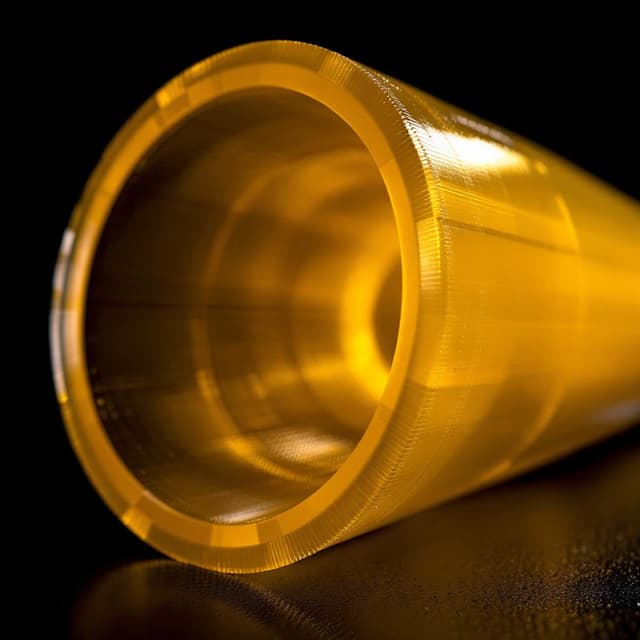
  • Amber/honey colour allows visual inspection for defects and part-thickness assessment in thin sections
  • Licensed Stratasys material system: rigorous, well-characterised manufacturing process with documented traceability

Limitations

  • FDM ONLY: ULTEM 1010 is not available as SLS or other AM powder — restricted to extrusion-based processes on Stratasys licensed systems
  • Stratasys license restriction: ULTEM 1010 FDM is only available on Stratasys Fortus machines (licensed material cartridge system). Open-market FDM printers cannot use this material
  • Higher material cost than PEEK or PEKK FDM per part — partly due to Stratasys licensing premium
  • Z-direction is weak (~63 MPa) due to interlayer bonding limitations — part orientation is critical; Z-loaded structures should not use FDM ULTEM 1010
  • Amorphous: NO benefit from post-annealing (unlike PEEK or PEKK) — crystallinity cannot be induced by thermal treatment
  • Brittle failure mode in both XY and Z — not suitable for impact-critical applications; elongation 1.8–3.3% at break
  • NSF 51 certification applies only to parts produced on Stratasys Fortus with Stratasys-certified ULTEM 1010 material, using validated print settings and documented traceability — third-party or open-parameter prints are not NSF certified
  • Higher processing temperature requirement (chamber 210°C) than PEEK or PEKK FDM — dedicated high-temperature chamber is mandatory; standard FDM printers are incompatible

Typical applications

Autoclave tooling and mandrels for composite lay-up (operates at 120–180°C, 6 bar pressure)High-temperature jigs and fixtures for aerospace composite cureSterilisation trays and autoclave-compatible surgical instrument holders (134°C)Food-processing equipment components in contact with food or beverages (NSF 51 certified)Aerospace ground support equipment (GSE) exposed to high temperaturesElectrical connector housings and insulator components requiring HDT >200°CHigh-temperature test fixtures and prototype housings for electronics validationIndustrial robot end-effectors and gripper components in high-temperature environmentsSemiconductor fab equipment components (clean-room compatible, high temperature)

Industries

aerospacemedicalfood-processingindustrial

Standards & certifications

ASTM-E8established

Tensile test method (ASTM D638 Type I is the polymer-specific equivalent)

aerospacemedicalfood-processingindustrial
ISO-52904established

Process quality assurance for safety-critical FDM ULTEM parts (aerospace, medical)

aerospacemedical

Compatible AM processes (1)

Other polymer materials

Related calculators

Last reviewed: 2026-05-13 · v1 · Sources: sabic-ultem-1010-2022, basgul-2018-fdm-polymers, zaldivar-2017-ultem-fdm, stratasys-ultem-9085-2023, ASTM-E8

Unlock the full property data — sign up free

Free account · no credit card · no marketing. Sign up to unlock the full library: 26 articles, 45 materials, 10 processes, 43 papers and more.