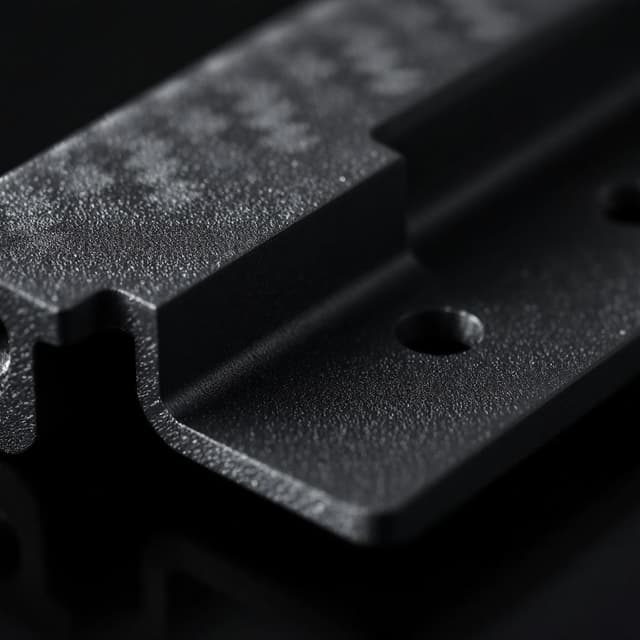
PA12-CF (Carbon Fibre PA12)
polymercarbon fibre reinforced polyamide-12 composite
Mechanical & thermal properties — 2 conditions
| Property | SLS as-built (XY) | SLS as-built (Z — vertical) |
|---|---|---|
| Elastic modulus | 5–6 GPa | 5–6 GPa |
| Yield strength (0.2%) | 46–58 MPa | 38–50 MPa |
| Ultimate tensile strength | 58–72 MPa | 46–58 MPa |
| Elongation at break | 2.0–5.0 % | 1.0–3.0 % |
| Density | 1.10 g/cm³ | 1.10 g/cm³ |
| As-built surface Ra | 12.0–20.0 µm | — |
Values shown as min–max where a spread is reported, otherwise as typical ± unit. Ranges reflect inter-source variation, not single-sample scatter. All values are for AM-processed specimens unless noted.
Engineering considerations
- Build orientation is the primary design decision: orient the highest-stiffness requirement in the XY plane. Z-direction modulus is ~9% lower than XY; Z-direction UTS is ~20% lower. For isotropic stiffness, consider unfilled PA12 or SLS glass-filled PA12 (EOS PA 3200 GF) as alternatives.
- Stress concentrations are critical: elongation at break is only ~3%. Fillets of R ≥ 1.5 mm at all internal corners and transitions. Avoid abrupt section changes. Use finite element analysis to check for local stress concentrations above 40 MPa — fracture initiates at stress risers.
- CF fibre length distribution: SLS processing partially degrades CF fibre length. Typical as-built chopped fibre length 0.05–0.15 mm post-sintering (starting from 0.1–0.3 mm). Shorter fibres reduce reinforcement efficiency. MJF HP CB PA12 tends to have more controlled fibre distribution than SLS.
- Powder refresh: enforce ≤40% recycled powder for structural applications. CF fibre degradation and matrix MFR increase with thermal history — track powder age carefully. For cosmetic or non-structural applications, up to 50% recycled powder is generally acceptable.
- EMI shielding: SLS PA12-CF parts exhibit volume resistivity ~10³–10⁵ Ω·cm depending on CF loading and porosity. For EMI shielding, specify minimum wall thickness (≥2 mm) for consistent conductive network. Verify shielding effectiveness (SE) by measurement — SLS porosity can disrupt CF conductive paths.
- Thermal conductivity: CF addition increases in-plane thermal conductivity vs unfilled PA12 (~0.3–0.5 W/m·K in XY vs ~0.16 W/m·K). Still low compared to metals — do not use as a thermal interface material without testing.
- Machinability: CF PA12 is machinable with carbide tooling. Drilling, reaming, and milling are possible. CF fibres are abrasive — tool life is reduced vs unfilled PA12 or metals. Use flood coolant or compressed air. Dust extraction essential (CF dust is a respiratory hazard and mildly irritant).
Advantages
- 3–4× higher stiffness than unfilled SLS PA12 (E 5.5 GPa vs 1.7 GPa) — enables thinner, lighter structures for the same deflection target
- Support-free powder bed process: no support removal marks, complex geometries including internal channels printable without supports
- Lower CTE than unfilled PA12 — better dimensional stability across temperature cycles
- Electrically conductive (surface and bulk) — CF content provides ~10³–10⁴ Ω·cm resistivity, enabling EMI shielding and ESD-safe parts
- Good specific stiffness: E/ρ ~5.0 GPa·cm³/g — competitive with aluminium alloy (70/2.7 ≈ 26) at much lower cost for complex shapes
- Higher hardness and wear resistance than unfilled PA12 — suitable for sliding surfaces and abrasive environments
- No post-cure required (vs photopolymer composites) — properties are final directly from the SLS process
Limitations
- Black only — CF content makes the material permanently black and non-dyeable. No colour options without paint/coating
- Reduced recyclability: 30–40% maximum refresh ratio recommended vs 50% for unfilled PA12 — CF fibres degrade with repeated thermal cycling, reducing reinforcement efficiency
- Higher surface roughness (Ra ~15 µm) than unfilled PA12 (~13 µm) due to protruding CF fibres — vapour smoothing less effective
- Brittle failure mode: elongation at break ~3% vs ~15% for PA12. Not suitable for impact-loaded or peel/flex loading applications
- Z-direction anisotropy significant: ~10–15% reduction in modulus and strength in Z relative to XY — orient parts carefully for primary load direction
- CF fibres are abrasive to SLS laser windows and recoater blades — machine wear rates increase with CF material. Check machine compatibility and consumable costs
- Higher powder cost than unfilled PA12 — CF powders are typically 1.5–2× the cost per kg of PA 2200
- Moisture sensitivity: matrix PA12 still absorbs moisture — CF does not, but matrix swelling affects dimensional stability and modulus at humidity equilibrium
Typical applications
Industries
Standards & certifications
Tensile testing of SLS/MJF composite polymer specimens (note: ASTM D638 preferred for polymers; E8 used here for cross-process comparability)
ASTM D638 Type I specimens are the standard for polymer tensile testing. E8 referenced for comparison with metal AM data. For CF-filled polymers, specimen geometry and gauge length strongly affect reported elongation — verify test conditions when comparing sources.
Compatible AM processes (2)
Other polymer materials
Related calculators
Unlock the full property data — sign up free
Free account · no credit card · no marketing. Sign up to unlock the full library: 26 articles, 45 materials, 10 processes, 43 papers and more.