Values shown as min–max where a spread is reported, otherwise as typical ± unit. Ranges reflect inter-source variation, not single-sample scatter. All values are for AM-processed specimens unless noted.
Engineering considerations
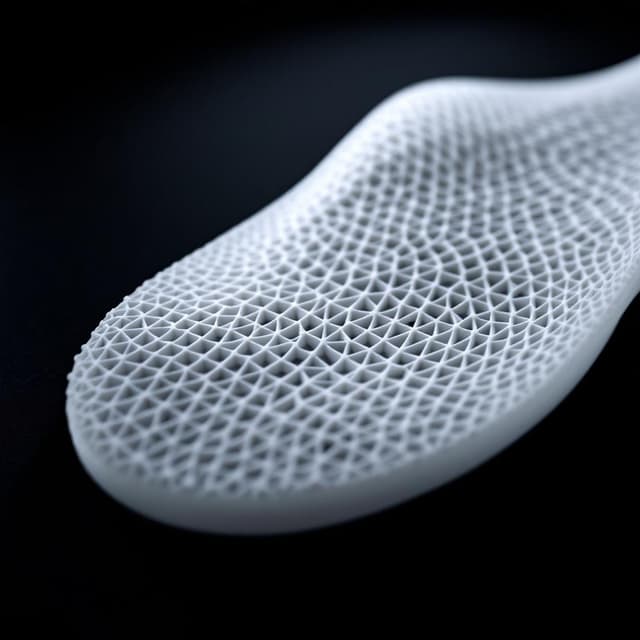
Lattice structure design for energy return: PEBA's unique property in AM is the ability to print support-free 3D lattice structures with tunable compliance. Use triply periodic minimal surface (TPMS) lattices (gyroid, Schwartz P) or BCC/octet truss for midsole applications. Target 20–35% volume fraction for midsole energy return — verify with drop tower or instron cyclic compression testing. Hyperelastic FEA (Mooney-Rivlin model) is required for accurate simulation.
Unlock the full property data — sign up to additive.tools
Membership · no credit card · no marketing emails. Unlock the full library: 28 articles, 46 materials, 10 processes, 75 papers and more.
Hardness grade selection: Pebax family spans Shore A 25 (Pebax 1074: very soft, high rebound) to Shore D 65 (Pebax 7233: near-rigid PA). For midsoles: Shore A 25–40 typical. For orthotics: Shore A 35–55 depending on patient weight and activity. For soft robotic grippers: Shore A 30–45. HP TPA 03 (Shore A 42) is a good general-purpose grade for MJF.
Elastic recovery and hysteresis: PEBA achieves >90% elastic recovery at strains below 30%, dropping to ~75–80% at 50% strain. For energy-return applications, design the lattice geometry to keep maximum local strut strain below 20–25% at peak load. Measure energy return per ISO 17707 (footwear sole testing) for midsole applications — correlate to lattice simulations.
Medical orthotic design: for custom orthotics, scan patient anatomy (structured light or CT), generate custom STL, print in PEBA. Key design parameters: wall thickness 1.5–3 mm for structural support, lattice fill for cushioning zones. Verify fit with 3D-scanned foot model before printing. Patient-specific AFOs with SLS PEBA outperform traditional thermoformed shells in comfort and compliance per clinical studies.
Temperature performance: PEBA remains elastic from –40°C to +80°C (polyether soft segment Tg ~–50 to –60°C). At service temperatures above 80°C, PA hard segments approach their softening range — PEBA loses structural integrity above ~100°C. For applications above 60°C, verify material selection with DMA thermal scan.
Powder management: PEBA powder is hygroscopic (polyether blocks absorb moisture). Store powder sealed with desiccant. Moisture affects flowability and sintering quality. Dry PEBA powder at 50°C for 4 h before use. Monitor powder MFR after each run — limit to 50% recycled powder for dimensional-critical applications.
Joining and assembly: PEBA parts can be adhesively bonded with polyurethane adhesives (PEBA–PU bond) or cyanoacrylate (with surface activation). For midsole–outsole assembly: polyurethane adhesive is standard (same as conventional foam midsole bonding). Mechanical fasteners are less suitable — PEBA's high elongation allows fastener pull-through. Ultrasonic welding possible with optimised amplitude and hold settings.
Advantages
Elastic energy return >90% at low strains (<30%) — highest of any common SLS/MJF elastomer. Enables true energy-return midsole performance vs foam (~55–70% return)
Lowest density elastomer available in SLS/MJF (1.01 g/cm³) — lighter than TPU (1.22 g/cm³) and comparable to PA12 (0.93 g/cm³)
Support-free powder bed process: internal lattice structures, undercuts, and complex flexible geometries printable without support removal marks
Tunable hardness: PEBA family spans Shore A 25 to Shore D 65 — select grade for specific stiffness requirement
Excellent cold-temperature flexibility: PEBA remains elastic to –40°C and below (polyether soft segments have very low Tg) — ideal for outdoor and cold-chain applications
Good chemical resistance: polyether blocks resist water, alcohols, and mild solvents. PA hard blocks provide structural integrity
Thermoplastic — fully recyclable (unlike crosslinked rubbers). Powder can be reused at standard refresh ratios
Biocompatible grades available: Pebax is skin-contact biocompatible; suitable for medical orthotics and wearable devices
Limitations
Only available in SLS and MJF — no FDM filament commercially available in standard PEBA grades. Cannot use on desktop FDM machines
Narrow SLS sintering window: PEBA powder processing requires precise bed temperature control — more challenging than PA12. Bed temperature uniformity critical to avoid warpage or incomplete fusion
Higher cost than PA12 powder: PEBA is typically 2–4× the powder cost per kg of PA12, plus higher machine time cost — not suitable for cost-driven prototyping
Limited material availability: fewer qualified PEBA powder sources than PA12. Primary SLS PEBA: Arkema/ELF Atochem. MJF: HP TPA 03. No open-parameter SLS PEBA widely available for non-EOS machines
Dimensional accuracy challenges: large elastic deformation makes dimensional measurement and tolerance specification non-trivial. Parts may deform during handling — design with appropriate handling fixtures
Not compatible with standard PA12 powder: PA12 and PEBA powders cannot be mixed in the same SLS bed. Dedicated machine or thorough cleaning required when switching materials
UV degradation: polyether blocks are susceptible to UV oxidation — outdoor PEBA parts require UV-stabilised surface coating for sustained outdoor use
Limited post-processing: dyeing is possible but less uniform than PA12. Vapour smoothing has limited effect on PEBA due to different solubility vs PA12. Surface texture is as-built sintered particle Ra ~12–18 µm
Typical applications
Sports shoe midsoles: SLS/MJF lattice structures for custom energy-return footwear (Adidas Futurecraft, Nike AM concept)Medical orthotics: custom ankle-foot orthoses (AFO), insoles, prosthetic socket liners requiring conformable flexibilityProsthetic interfaces: PEBA liners between prosthetic socket and residual limb — comfort and impact absorptionFlexible connectors and bellows: chemical-resistant flexible joints in tube and hose assembliesVibration dampers and isolation mounts: SLS lattice structures tuned for specific frequency dampingSoft robotic grippers: compliant end-effectors for delicate assembly and pick-and-place operationsLattice energy-return structures: topology-optimised lattice midsoles, cushioning pads, and impact absorbersWearable device straps and body-contact components: skin-safe, flexible, lightweightMedical device seals and gaskets: autoclave-compatible with good chemical resistanceSports protective padding: custom-fit impact protection (helmets, body armour) using lattice PEBA
Process quality assurance for SLS/MJF polymer parts — applicable to PEBA for medical orthotic and prosthetic liner production
medicalconsumer
PEBA for medical orthotics requires additional compliance with ISO 10993 biocompatibility (skin-contact devices). Pebax grades (Arkema) have documented biocompatibility for skin-contact applications. HP TPA 03: verify biocompatibility documentation with HP for specific device class. For Class II or higher medical devices, full ISO 10993 test program required beyond material compliance.