Laser Powder Bed Fusion
SLMDMLSDMLMLaserCUSINGPBF-LB/MYtterbium fibre laser, typically 200–1000 W, wavelength 1060–1080 nm (near-infrared). Multi-laser configurations: 2, 4, 8, or 12 lasers in parallel.
How it works
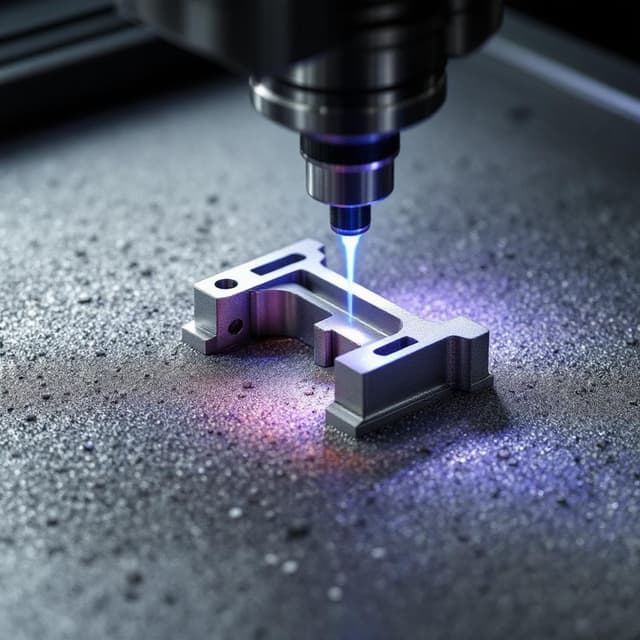
A fine powder (typical D50 10–45 µm) is spread in a thin layer (~20–100 µm) across a build platform by a recoater blade or roller. A focused laser beam traces the cross-section of each layer, selectively melting the powder to form a dense melt pool that fuses to the previous layer upon solidification. Unmelted powder supports the part and is recovered for reuse. The process occurs in a sealed chamber purged with argon or nitrogen to an oxygen level below 500–1000 ppm. Repeating layer-by-layer produces a three-dimensional near-net-shape component with typically >99.5% relative density. Residual stress builds up due to rapid thermal gradients — most metals require stress relief after build.
Parameter envelopes (6 material–machine combinations)
Power
200–340 W (typ. 280 W)
Scan speed
800–1800 mm/s
Layer thickness
30–60 µm
Hatch spacing
100–140 µm
Max O₂
500 ppm
Preheat
35 °C
VED optimal
55–70 J/mm³
EOS standard parameter set for Ti-6Al-4V on M 290 at 30 µm layer. Preheat to 35°C minimises first-layer thermal shock. VED above 80 J/mm³ risks keyhole porosity; below 50 J/mm³ risks LOF defects.
Power
180–370 W (typ. 275 W)
Scan speed
700–1400 mm/s
Layer thickness
20–50 µm
Hatch spacing
90–130 µm
Max O₂
1000 ppm
Preheat
80 °C
VED optimal
65–90 J/mm³
Nitrogen atmosphere is acceptable and cheaper than argon for 316L. Preheat to 80°C reduces residual stress and improves dimensional accuracy on complex geometries.
Power
250–400 W (typ. 370 W)
Scan speed
1300–2200 mm/s
Layer thickness
30–60 µm
Hatch spacing
130–190 µm
Max O₂
1000 ppm
Preheat
150 °C
VED optimal
50–65 J/mm³
AlSi10Mg requires 150–200°C preheat to prevent thermal cracking. Al reflects ~8% of 1070 nm laser — higher power required vs steel. Hot tearing risk above 200°C preheat with some alloys.
Power
250–400 W (typ. 285 W)
Scan speed
800–1400 mm/s
Layer thickness
20–60 µm
Hatch spacing
90–130 µm
Max O₂
500 ppm
Preheat
80 °C
VED optimal
60–85 J/mm³
IN718 is susceptible to hot cracking at high VED. Columnar grain texture and Laves phase formation are as-built. All structural applications require SA+DA heat treatment.
Power
150–300 W (typ. 200 W)
Scan speed
700–1300 mm/s
Layer thickness
20–40 µm
Hatch spacing
80–120 µm
Max O₂
500 ppm
Preheat
80 °C
VED optimal
80–110 J/mm³
CoCrMo has high laser absorptivity (~45% at 1070 nm). High hardness (as-built ~35 HRC) makes support removal difficult — minimise support contacts or use breakaway pedestals.
Power
150–370 W (typ. 200 W)
Scan speed
700–1400 mm/s
Layer thickness
20–50 µm
Hatch spacing
80–120 µm
Max O₂
500 ppm
Preheat
35 °C
VED optimal
60–80 J/mm³
Maraging MS1 as-built is ductile soft martensite (~33 HRC). Machine in soft state, then age at 480°C/6h for 54 HRC. Near-zero dimensional change on ageing (<0.1% linear). No quench required.
Defect modes (6)
Keyhole Porosity
Cause
Excessive Volumetric Energy Density (VED) above the keyhole threshold, typically >80–100 J/mm³ for most alloys. The laser creates a deep, narrow vapour-filled cavity (keyhole) that collapses and traps gas.
Indicator
Spherical pores (diameter 20–200 µm) visible in cross-section micrographs or X-ray CT. Located within scan tracks, not at layer interfaces. Often associated with spatter ejection during build.
Prevention
Reduce laser power or increase scan speed to lower VED. Avoid high-power, low-speed parameter combinations. Characterise keyhole threshold using single-track experiments or VED parameter maps.
Detection
- X-ray CT
- Archimedes density measurement
- metallographic cross-section
Lack-of-Fusion (LOF) Porosity
Cause
Insufficient Volumetric Energy Density: laser does not fully melt the current powder layer or fails to re-melt and bond to the previous layer. Causes: low power, high speed, excess layer thickness, excessive hatch spacing, or degraded powder flowability.
Indicator
Irregular, elongated pores (typically 50–500 µm, aspect ratio >2) often containing unmelted powder particles. Located at layer interfaces or between scan tracks. Catastrophic effect on fatigue life.
Prevention
Maintain VED within validated process window. Use layer thickness ≤particle D90. Ensure powder is dry and within specified refresh ratio. Monitor recoater deposition quality (in-process imaging if available).
Detection
- X-ray CT
- metallographic cross-section
- HIP (remediation, not detection)
Residual Stress and Distortion
Cause
Steep thermal gradients (~10⁶ K/m) from the highly localised laser energy input create differential thermal contraction stresses during cooling. The build plate and support structures constrain the part, building up tensile stress in the top layers and compressive stress in the bottom.
Indicator
Part warps or distorts when removed from build plate. Scan tracks visible as bands of different microstructure in etched cross-sections. Stress relief cracking in susceptible alloys (some IN718, some high-carbon steels).
Prevention
Apply stress relief or HIP post-processing. Use chessboard or island scan strategy to reduce long scan track lengths. Preheat build plate (>80°C for steels, 150°C for aluminium). Simulate residual stress with process simulation software before build.
Detection
- Neutron diffraction (bulk)
- X-ray diffraction (surface)
- strain gauges
- coordinate measuring machine (CMM) before/after wire-EDM release
Columnar Grain Texture and Anisotropy
Cause
Directional heat extraction along the build direction (Z-axis) during rapid solidification promotes epitaxial grain growth producing <100> textured columnar grains aligned with the Z-axis. This is intrinsic to LPBF physics, not a defect in the traditional sense, but causes mechanical anisotropy: Z-direction properties are typically 5–15% lower than XY for metals.
Indicator
Columnar grain structure visible in EBSD or optical metallography. Mechanical testing shows directional dependence (XY stronger than Z in tensile, opposite in compression in some alloys).
Prevention
Cannot be fully eliminated without HIP or heat treatment. Can be mitigated by: high preheat (>150°C), post-process HIP, or process optimisation for fine equiaxed grains. Grain refiners (Sc, Zr additions to Al alloys) can promote equiaxed solidification.
Detection
- EBSD
- optical metallography
- dual-axis mechanical testing (XY vs Z specimens)
Surface Roughness and Staircase Effect
Cause
Layer-by-layer construction creates staircase steps on inclined surfaces. Down-facing surfaces (overhangs) are rougher (Ra 20–60 µm) than up-facing (Ra 5–15 µm) due to partial particle attachment. Spatter particles adhere to near-vertical walls.
Indicator
Ra > 15 µm on inclined surfaces. Visual staircase pattern at low-angle slopes (<45° from horizontal). Unmelted powder particles embedded in down-skin surfaces.
Prevention
Design with minimum 45° overhang angles. Use contour scan parameters optimised for surface quality (lower power, multiple contour passes). Post-process: abrasive flow machining, electrochemical polishing, shot peening, or CNC machining.
Detection
- Contact profilometer (Ra per ISO 4288)
- non-contact white light interferometry (Sa per ISO 25178)
Hot Cracking / Liquation Cracking
Cause
Found primarily in crack-susceptible alloys (CM 247LC, CMSX-4, some Al alloys). Low solidification range alloys with wide mushy zones, or alloys with low-melting grain boundary phases, crack during cooling due to thermal stress exceeding the local hot-strength.
Indicator
Intergranular cracks, typically located at prior austenite grain boundaries or near Laves phase regions (IN718). Often branching and irregular. Visible in etched optical or SEM micrographs.
Prevention
Increase preheat temperature (≥500°C for crack-susceptible Ni superalloys via EBM, which has lower residual stress). Apply HIP to close cracks after build. Select crack-resistant alloy compositions (e.g., Alloy 718C vs. standard 718). Use EBM instead of LPBF for problematic alloys.
Detection
- Fluorescent penetrant inspection (FPI/FPI)
- X-ray CT
- metallographic cross-section