Maraging Steel MS1 (18Ni-300)
metalmaraging steel (ultra-high-strength, precipitation-hardened)
18Ni-300DIN 1.2709UNS K93120EOS MS1Vascomax 300AMS 6514 (wrought ref.)
Composition — DIN 1.2709 / UNS K93120 / AMS 6514
| Element | Min % | Max % | Notes |
|---|---|---|---|
| Ni | 17.00 | 19.000 | High Ni for martensite transformation without carbon; key for intermetallic precipitation |
| Co | 8.50 | 9.500 | Lowers martensite finish temperature; promotes Mo precipitation on ageing |
| Mo | 4.50 | 5.200 | Primary age-hardening precipitate Ni₃Mo; solid solution strengthener |
| Ti | 0.50 | 0.800 | Forms Ni₃Ti precipitates; critical for achieving peak hardness on ageing |
| Al | 0.05 | 0.150 | Deoxidiser; promotes ordered Ni₃(Al,Ti) phase |
| Fe | bal. | balance | |
| C | — | 0.030 | Low carbon is essential — carbon in martensite causes brittleness. 'Maraging' = martensite + ageing (no carbon hardening) |
| Mn | — | 0.100 | |
| Si | — | 0.100 | |
| P | — | 0.010 | |
| S | — | 0.010 | |
| Zr | — | 0.010 | |
| B | — | 0.003 | Grain boundary strengthener; suppresses grain boundary failure during ageing |
Mechanical & thermal properties — 3 conditions
| Property | LPBF as-built (XY) — soft martensite | LPBF aged 480°C/6h (XY) — peak hardness | LPBF aged 480°C/6h (Z) |
|---|---|---|---|
| Elastic modulus | 170–190 GPa | — | — |
| Yield strength (0.2%) | 940–1150 MPa | 1760–1970 MPa | 1640–1860 MPa |
| Ultimate tensile strength | 1030–1270 MPa | 1870–2100 MPa | 1750–1980 MPa |
| Elongation at break | 7.0–15.0 % | 2.0–7.0 % | 1.5–5.0 % |
| Hardness (HV) | 340–410 HV10 | 530–610 HV10 | 520–600 HV10 |
| Fatigue strength | — | 650–850 MPa | — |
| Density | 8.05 g/cm³ | — | — |
| Thermal conductivity | 16.0–18.5 W/m·K | — | — |
| CTE | 10.2–11.2 µm/m·K | — | — |
Values shown as min–max where a spread is reported, otherwise as typical ± unit. Ranges reflect inter-source variation, not single-sample scatter. All values are for AM-processed specimens unless noted.
Engineering considerations
- Ageing protocol: 480–490°C for 4–8h (vacuum preferred, inert atmosphere acceptable). Peak hardness at ~5–6h at 480°C. Over-ageing at 500°C+ causes precipitate coarsening and hardness loss. Measure hardness after each ageing batch.
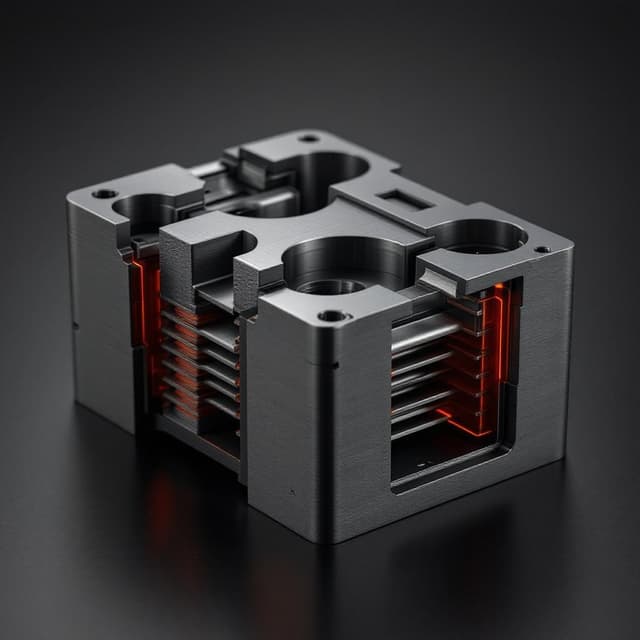
- Tooling design for conformal cooling: minimum channel diameter 1.5 mm (printable), typical 3–5 mm for cooling channels. Channel wall thickness minimum 1.5 mm to handle injection pressure (up to 200 MPa). Use computational mould flow analysis to optimise channel layout.
- Dimensional change on ageing: linear shrinkage 0.05–0.08% — account for this in pre-age dimensions when tolerances are tight (±0.01 mm).
- Surface finish for mould inserts: as-built Ra 10–15 µm. Post-machining to Ra <0.4 µm (polished), then EDM or hand polishing to Ra <0.1 µm (mirror) for Class A cosmetic surfaces.
- Fatigue in tooling: typical injection mould tool sees 10–50 million cycles over lifetime. Design for 10⁷ cycle endurance at nominal stress — use FEA to verify gate and runner areas where stress concentrations occur.
- Heat treatment sequence for tooling inserts: LPBF → stress-relieve (300°C/1h, reduces distortion risk) → machine cavity to near-final size → age (480°C/5h) → finish grind/EDM/polish.
- Welding/repair: maraging steel responds well to laser micro-welding using matching 18Ni filler wire. Post-weld local ageing (480°C/3h at weld zone) restores hardness without full re-ageing the tool.
- Print orientation for tooling: print the mould cavity face in XY (highest mechanical properties at the contact surface). Gate areas should be in XY if possible — highest cyclic stress location.
Advantages
- Highest strength of any standard LPBF metal — YS 1870 MPa, UTS 1990 MPa (aged) surpasses all other AM metals
- Near-zero dimensional change on ageing (<0.1% linear) — machine in soft state, age to final hardness
- Achieves injection mould tool hardness (52–54 HRC) without quench-and-temper distortion risk
- Conformal cooling channels: LPBF enables complex internal channels impossible in machined H13/P20 tooling — 20–40% cycle time reduction in injection moulding
- Good machinability in as-built state (37–40 HRC) — conventional machining with carbide tooling
- Good EDM machinability — electrode wear is low; important for mould cavity finishing
- Isotropic ageing response — hardness is uniform regardless of build orientation
- Weldable (laser and TIG) with maraging 18Ni filler — mould repair without re-aging in some cases
Limitations
- Very low ductility after ageing (2–7%) — not suitable for impact loading or crash-absorbing structures
- Mandatory ageing required for structural use — as-built properties (37 HRC) are insufficient for tooling
- High cost: raw powder 4–6× more expensive than tool steel P20 per kg. Cost-justified primarily for complex conformal cooling tooling
- Co content raises bio-release concerns for implantable devices — not used for medical implants
- Over-ageing above 510°C causes Ni₃Mo dissolution and hardness reduction — temperature control within ±5°C is critical
- Susceptible to hydrogen embrittlement in certain plating processes — avoid acid pickling without pre-bake
- Limited corrosion resistance compared to stainless — may require surface coating (TiN, CrN PVD) for corrosive media exposure
- Print parameter sensitivity: maraging steel has narrow VED window for optimal density; deviations cause LOF porosity that reduces fatigue life
Typical applications
Injection mould inserts with conformal cooling channelsDie-casting inserts and die-casting toolingHigh-pressure forming tools and press hardening diesAerospace structural brackets and fasteners (ultra-high-strength)Motorsport suspension components and uprightsRocket engine thrust chambers and nozzle hardwareHigh-performance cutting tool bodies and insertsPrecision jigs and fixtures requiring high dimensional stabilityUnderwater and ballistic components requiring extreme strength
Industries
toolingaerospacemotorsportdefence
Standards & certifications
Compatible AM processes (1)
Other metal materials
Ti-6Al-4V Grade 5titanium alloy — alpha-beta316L Stainless Steelaustenitic stainless steel17-4PH Stainless Steelmartensitic precipitation-hardening stainless steelAlSi10Mgaluminium-silicon alloy (cast grade adapted for AM)AlSi7Mg Aluminium Alloyhypoeutectic Al-Si-Mg precipitation-hardenable aluminium alloyInconel 718nickel superalloy — precipitation-hardenedInconel 625nickel superalloy — solid-solution-strengthenedCoCrMocobalt-chromium alloy (biomedical and aerospace grade)H13 Tool Steelchromium-molybdenum hot-work tool steel
Related calculators
HT AdvisorStandard stress-relief, solution, and aging cycles for AM metals (Ti-6Al-4V, IN718, 17-4PH, AlSi10Mg, 316L, CuCrZr) per AMS, ASTM F3301, and AMS 5664.DistortionEstimate residual stress and distortion risk index (σ/σ_y) for LPBF and DED builds. Mercelis-Kruth model with preheat sensitivity table.VEDCompute LPBF VED from power, scan speed, hatch, and layer thickness. Includes process windows for common alloys.Melt PoolLPBF / DED melt pool depth, width, and cooling rate from the Rosenthal moving heat source solution. Absorptivity, thermal diffusivity, and solidification velocity.HIPRecommended HIP temperature, pressure, and dwell time for AM metals per ASTM F3301, AMS 2801, and DEF STAN 02-835. Covers Ti alloys, Ni superalloys, steels.
Last reviewed: 2026-05-04 · v1 · Sources: eos-ms1-2023, kempen-2011-ms1, bai-2017-ms1, debroy-2018-review, yadollahi-2017-fatigue, ASTM-E8, ASTM-E466