17-4PH Stainless Steel
metalmartensitic precipitation-hardening stainless steel
UNS S174001.4542 (EN)AMS 5622630 SSAISI 63017-4 PHX5CrNiCuNb17-4 (EN)SUS 630 (JIS)
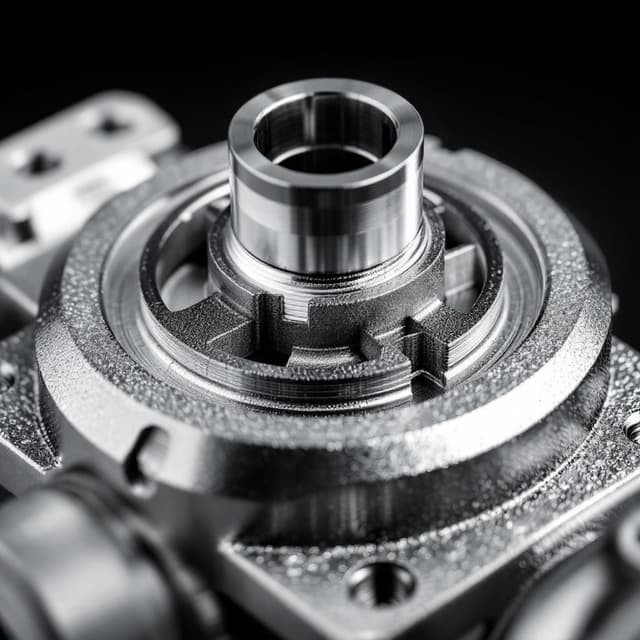
Composition — UNS S17400 / AMS 5622 / ASTM A693
| Element | Min % | Max % | Notes |
|---|---|---|---|
| Cr | 15.00 | 17.500 | Primary corrosion resistance element; forms passive Cr₂O₃ film |
| Ni | 3.00 | 5.000 | Stabilises martensite on cooling; austenite-former |
| Cu | 3.00 | 5.000 | Primary precipitation-hardening element — Cu-rich precipitates form during aging |
| Nb | 0.15 | 0.450 | Nb+Ta: stabilises composition during AM solidification; limits grain growth |
| Fe | bal. | balance | |
| C | — | 0.070 | Low carbon essential for weldability and corrosion resistance; higher C shifts martensite start temperature |
| Mn | — | 1.000 | |
| Si | — | 1.000 | |
| P | — | 0.040 | |
| S | — | 0.030 |
Mechanical & thermal properties — 3 conditions
| Property | LPBF + H900 (XY) | LPBF + H1025 (XY) | LPBF + H900 (Z — build direction) |
|---|---|---|---|
| Elastic modulus | 197 GPa | 197 GPa | — |
| Yield strength (0.2%) | 1100–1240 MPa | 965–1060 MPa | 1020–1180 MPa |
| Ultimate tensile strength | 1210–1340 MPa | 1000–1130 MPa | 1170–1310 MPa |
| Elongation at break | 7.0–14.0 % | 10.0–17.0 % | 6.0–12.0 % |
| Hardness (HV) | 380–460 HV10 | 330–380 HV10 | — |
| Density | 7.78 g/cm³ | 7.78 g/cm³ | — |
| Thermal conductivity | 17.0–19.5 W/m·K | — | — |
| CTE | 10.2–11.5 µm/m·K | — | — |
Values shown as min–max where a spread is reported, otherwise as typical ± unit. Ranges reflect inter-source variation, not single-sample scatter. All values are for AM-processed specimens unless noted.
Engineering considerations
- Phase control: always solution treat (Condition A, 1038°C/0.5h/AC) before aging regardless of as-built microstructure. Skipping Condition A when using N₂-atomised powder results in retained austenite and unpredictable properties below spec.
- Powder selection: specify Ar-atomised powder when as-built martensitic structure is needed. N₂-atomised powder may be acceptable for binder jetting (fully sintered, phase resets), but must be Condition A treated before aging.
- Anisotropy: Z-direction yield strength ~5% lower than XY per AMS 7008. Orient primary load paths in XY plane for peak performance. AMS 7008 minimum XY: 1100 MPa; Z: 1034 MPa (H900).
- Aging sequence for tight tolerances: rough machine in as-built or Condition A state → age → finish machine. Aging distortion is minimal (<0.05% linear) but finish machining after aging avoids residual stress redistribution.
- H900 vs H1025 selection: H900 maximises strength (1150 MPa YS) at the cost of ductility (10% El) and notch toughness. H1025 (1000 MPa YS, 13% El) preferred for parts with threads, holes, or impact loading.
- Corrosion: passivation in HNO₃ or citric acid after all machining operations. 17-4PH is susceptible to crevice corrosion and stress corrosion cracking (SCC) in H900 condition in warm salt water — use H1025 or higher for marine-adjacent environments.
- Binder jetting note: sintering at ~1260–1300°C, ~15–17% linear shrinkage is typical. Final density ≥97.5% achievable; requires Condition A + age cycle identical to LPBF to achieve equivalent properties. Dimensional tolerances: ±0.3–0.5% after sintering.
- Magnetic properties: fully martensitic 17-4PH is strongly ferromagnetic (µr ~80–90). Retained austenite after LPBF with N₂ powder reduces magnetism — check lot-to-lot consistency for magnetically-sensitive assembly requirements.
Advantages
- Wide strength-toughness range adjustable through aging temperature (H900–H1150) without requenching
- Good corrosion resistance — superior to 316L in oxidising environments, comparable in Cl⁻-containing environments
- Near-zero dimensional change during aging: machine in soft state, then age to final hardness
- High hardness (H900: ~40 HRC) without brittle martensite — Cu-rich precipitate mechanism unlike carbon steels
- Good machinability in all aged conditions — better than austenitic SS due to martensitic structure
- Qualified for aerospace per AMS 7008 and AMS 5622; extensive flight heritage
Limitations
- As-built LPBF phase constitution depends on powder lot and atomisation gas — requires consistent powder sourcing
- Lower corrosion resistance than 316L in reducing/chloride environments (no Mo content)
- Strength markedly lower than maraging steels or tool steels — not suitable for tooling inserts
- Magnetic: not suitable where non-magnetic material is required (MRI-adjacent, sensitive electronics)
- H900 condition is notch-sensitive — careful design around stress concentrations and threaded features
- Binder jetting 17-4PH requires careful sintering cycle control — 15–17% linear shrinkage; higher dimensional uncertainty than LPBF
Typical applications
Aerospace structural brackets and fasteners (AMS 7008)Landing gear and hydraulic componentsChemical processing valves and pumpsMedical surgical instrumentsFood/pharmaceutical processing equipmentDefence and firearm componentsOil & gas downhole tools
Industries
aerospacedefencemedicaloil-gasfood-processing
Standards & certifications
AMS-7008established
LPBF 17-4PH (UNS S17400) for aerospace — powder composition, heat treatment cycles, and minimum mechanical property requirements for H900 and H1025 conditions
aerospacedefence
ASTM-A693established
Precipitation-hardening stainless steel plate, sheet, and strip including 17-4PH — composition, mechanical property grades
industrialoil-gasfood-processing
ASTM-E8established
Uniaxial tensile testing method for mechanical property acceptance testing of AM specimens
aerospacemedicalindustrial
ASTM-E92established
Vickers hardness testing method for hardness verification at H900/H1025/H1150 condition
aerospaceindustrial
Compatible AM processes (2)
Other metal materials
Ti-6Al-4V Grade 5titanium alloy — alpha-beta316L Stainless Steelaustenitic stainless steelAlSi10Mgaluminium-silicon alloy (cast grade adapted for AM)AlSi7Mg Aluminium Alloyhypoeutectic Al-Si-Mg precipitation-hardenable aluminium alloyInconel 718nickel superalloy — precipitation-hardenedInconel 625nickel superalloy — solid-solution-strengthenedCoCrMocobalt-chromium alloy (biomedical and aerospace grade)Maraging Steel MS1 (18Ni-300)maraging steel (ultra-high-strength, precipitation-hardened)H13 Tool Steelchromium-molybdenum hot-work tool steel
Related calculators
HT AdvisorStandard stress-relief, solution, and aging cycles for AM metals (Ti-6Al-4V, IN718, 17-4PH, AlSi10Mg, 316L, CuCrZr) per AMS, ASTM F3301, and AMS 5664.DistortionEstimate residual stress and distortion risk index (σ/σ_y) for LPBF and DED builds. Mercelis-Kruth model with preheat sensitivity table.VEDCompute LPBF VED from power, scan speed, hatch, and layer thickness. Includes process windows for common alloys.Melt PoolLPBF / DED melt pool depth, width, and cooling rate from the Rosenthal moving heat source solution. Absorptivity, thermal diffusivity, and solidification velocity.HIPRecommended HIP temperature, pressure, and dwell time for AM metals per ASTM F3301, AMS 2801, and DEF STAN 02-835. Covers Ti alloys, Ni superalloys, steels.
Last reviewed: 2026-05-05 · v1 · Sources: eos-17-4ph-2023, AMS-7008, debroy-2018-review