additivetools

Ti-6Al-4V ELI (Grade 23)

metal

titanium alloy — alpha-beta (extra low interstitial)

Ti64 ELIGrade 23 TitaniumUNS R56401Ti-6Al-4V ELIASTM F136 Ti alloyMedical Grade Ti64
Density
4.43 g/cm³
YS (LPBF as-built (XY))
930–1120 MPa
UTS (LPBF as-built (XY))
1050–1280 MPa
Elongation (LPBF as-built (XY))
5.0–13.0 %
Elastic modulus
105–120 GPa
Thermal conductivity
6.7 W/m·K

Composition — UNS R56401 / ASTM F3001-14 / ASTM F136

ElementMin %Max %Notes
Tibal.balance
Al5.506.500Alpha stabiliser; narrows range vs. Grade 5 (5.5–6.75) for tighter microstructure control
V3.504.500
Fe0.250Reduced from 0.30% (Grade 5) — Fe is a beta stabiliser that affects transformation behaviour
O0.130Key interstitial — primary driver of ductility and fracture toughness improvement vs. Grade 5. Oxygen strengthens but embrittles; ELI reduces O limit from 0.20% to 0.13%.
N0.030Reduced from 0.05% (Grade 5)
C0.080
H0.012Slightly lower H limit than Grade 5 (0.015%) — hydrogen embrittlement is a concern in implant environments (in vivo)
Y0.005

Mechanical & thermal properties — 4 conditions

PropertyLPBF as-built (XY)LPBF annealed (700–800°C / 2h / AC) (XY)LPBF + HIP (920°C / 100 MPa / 2h)EBM as-built
Elastic modulus105–120 GPa
Yield strength (0.2%)930–1120 MPa759–1000 MPa780–930 MPa760–920 MPa
Ultimate tensile strength1050–1280 MPa860–1050 MPa860–1010 MPa860–1000 MPa
Elongation at break5.0–13.0 %10.0–20.0 %13.0–24.0 %12.0–21.0 %
Hardness (HV)295–355 HV10
Fatigue strength480–680 MPa620–820 MPa
Fracture toughness KIC60.0–95.0 MPa√m72.0–110.0 MPa√m
Density4.43 g/cm³4.43 g/cm³
Relative density99.0–100.0 %
Thermal conductivity6.7 W/m·K
CTE8.4–9.0 µm/m·K
As-built surface Ra20.0–45.0 µm

Values shown as min–max where a spread is reported, otherwise as typical ± unit. Ranges reflect inter-source variation, not single-sample scatter. All values are for AM-processed specimens unless noted.

Engineering considerations

  • Implant qualification pathway (US): ASTM F3001 for powder and part properties, FDA AM Guidance 2017 for 510(k)/PMA submission. Device-level testing (ISO 7206 for hip, ASTM F3141 for spine, ISO 14801 for dental) is required regardless of material compliance.
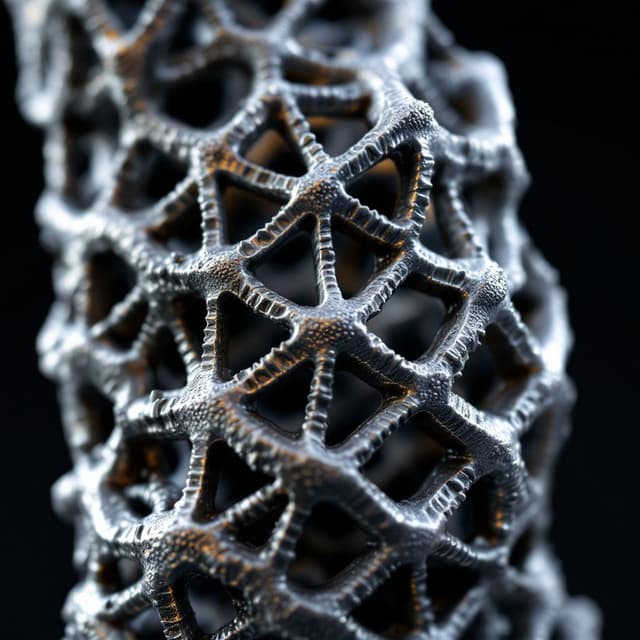
  • EBM for orthopaedics: lattice design for osseointegration should target pore size 300–600 µm and porosity 50–70% — these values are empirically proven for bone ingrowth. EBM Arcam A2XX series is the dominant platform for orthopaedic Ti-6Al-4V ELI.
  • LPBF for medical: stress relief (600°C/2h in vacuum) plus solution anneal (730–800°C/2h, furnace cool) is the standard post-processing route for LPBF ELI implants. HIP (920°C/100 MPa/2h) adds cost but is justified for fracture-critical spinal implants.
  • Anisotropy consideration: for spinal cages loaded in axial compression (primary load), the Z-direction (lowest LPBF strength) is aligned with the loading axis — design for worst-case Z-direction properties unless post-HT restores isotropy.
  • Wear surfaces: Ti-6Al-4V ELI is unsuitable as a bearing surface without modification. For modular neck tapers and femoral head interfaces, specify: (a) PVD TiN coating (HV 2000, Ra < 0.1 µm), (b) anodised TiO₂ (corrosion protection), or (c) mate with UHMWPE, CoCrMo ceramic, or alumina.
  • Sterilisation compatibility: steam autoclave (134°C, compatible), gamma irradiation (25 kGy, compatible), EtO (compatible). Select final finish before sterilisation — passivation per ASTM F86 recommended before gamma or EtO sterilisation.
  • Osseointegration surface design: as-built EBM surfaces (Ra 20–35 µm) provide excellent primary fixation. Further roughening via grit blasting or acid etching is used when Ra > 35 µm osseointegration texture is desired. Do not polish osseointegration surfaces.
  • Regulatory note: EU MDR 2017/745 Class III (implantable devices) requires Notified Body involvement. Clinical evaluation and post-market follow-up are mandatory in addition to material and device testing.

Advantages

  • Biocompatible — ASTM F136 / ISO 5832-3 certified; no cytotoxicity, genotoxicity, or immunogenicity concerns for long-term implantation
  • Superior fracture toughness vs. Grade 5 — KIC ~80–90 MPa√m vs. ~55–70 MPa√m — critical for fracture-critical implants
  • Better fatigue crack growth resistance — lower crack propagation rate in body fluid environment vs. Grade 5
  • Meets ASTM F3001 property minimums as-built after EBM — simplifies implant qualification pathway
  • EBM enables porous osseointegration structures and solid regions in a single build — no assembly
  • Elastic modulus (110–115 GPa) closer to cortical bone (10–30 GPa) vs. cobalt chrome (200 GPa) — reduces stress shielding
  • Excellent corrosion resistance in body fluids — passive TiO₂ film is stable in saline, pH 5–9, and plasma

Limitations

  • Lower yield and UTS than Grade 5 — ~10% less strength due to lower O content. Acceptable for most implant designs but requires awareness in structural analysis
  • LPBF as-built elongation (5–8%) insufficient for implant standards — annealing mandatory for LPBF medical applications
  • Poor wear resistance — Ti alloys are not suitable for bearing surfaces without coating (TiN, TiO₂) or ceramic insert
  • Extremely high cost — ELI grade powder is typically 20–40% more expensive than Grade 5 powder
  • EBM surface roughness (Ra 20–45 µm) — bearing surfaces require machining to Ra < 0.1 µm; adds cost and setup complexity
  • Titanium is MRI compatible but causes imaging artefacts — plan implant orientation to minimise diagnostic shadow
  • No published AM ELI fatigue endurance standard — each implant design requires device-level fatigue testing to ISO 7206, ASTM F1800, or equivalent
  • Powder handling: same ATEX/OSHA requirements as Grade 5; ELI powder must be handled in inert atmosphere due to fine particle reactivity

Typical applications

Total hip arthroplasty — femoral stems and acetabular cups with porous lattice for osseointegration (EBM)Total knee arthroplasty — tibial trays and augments with porous ingrowth structures (EBM)Spinal interbody fusion cages — PLIF, TLIF, ALIF cages with porous scaffold for bone growth through implantDental implants and abutments — patient-specific and standard prosthetic implantsTrauma implants — bone plates, screws, and intramedullary nails (fracture-critical → ELI preferred over Grade 5)Patient-specific implants (PSI) — craniofacial, maxillofacial, mandibular reconstructionSurgical instruments requiring biocompatibility and sterilisabilityAerospace fracture-critical brackets and fittings where KIC is the design driver

Industries

medicaldentalaerospacedefence

Standards & certifications

ASTM-F3001established

Ti-6Al-4V ELI parts produced by powder bed fusion (LPBF and EBM) — defines composition, powder, and minimum mechanical property requirements for the ELI grade

medicalaerospace

The primary AM standard for ELI grade. Mechanical property minimums are equivalent to wrought ASTM F136 — this enables AM implant qualification using the same acceptance criteria as wrought.

ASTM-F2924established

Grade 5 Ti-6Al-4V — referenced for comparison; ELI grade (F3001) has lower property minimums due to reduced interstitial content

aerospacedefence
ISO-5832-3established

Wrought Ti-6Al-4V reference standard for implant property comparison

medical

Wrought ELI reference. AM ELI implants must also satisfy FDA AM Guidance 2017 (US) or EU MDR Annex II (Europe).

ISO-13485established

Medical device quality management system — required for implant manufacturers

medical
ISO-10993-1established

Biocompatibility evaluation framework — required for all implantable AM devices

medical

FDA guidance for AM medical devices — submission requirements for 510(k) and PMA

medical

Compatible AM processes (2)

Other metal materials

Ti-6Al-4V Grade 5titanium alloy — alpha-betaCP-Titanium Grade 2commercially pure titanium — alphaCP-Ti Grade 4titanium — commercially pure alphaTi-6Al-2Sn-4Zr-2Motitanium alloy — near-alpha316L Stainless Steelaustenitic stainless steel304L Stainless Steelaustenitic stainless steel17-4PH Stainless Steelmartensitic precipitation-hardening stainless steel15-5 PH Stainless Steelmartensitic precipitation-hardened stainless steel420 Stainless Steelmartensitic stainless steelAlSi10Mgaluminium-silicon alloy (cast grade adapted for AM)AlSi7Mg Aluminium Alloyhypoeutectic Al-Si-Mg precipitation-hardenable aluminium alloyScalmalloy®aluminium alloy — Al-Mg-Sc-ZrAlSi12aluminium — hypoeutectic/eutectic Al-SiInconel 718nickel superalloy — precipitation-hardenedInconel 625nickel superalloy — solid-solution-strengthenedInconel 939nickel superalloy — γ'-precipitation-hardened (high Al+Ti)Hastelloy® Xnickel superalloy — solid-solution strengthenedWaspaloy®nickel superalloy — γ'-precipitation-hardenedHaynes 282nickel superalloy — γ' precipitation-hardenedCoCrMocobalt-chromium alloy (biomedical and aerospace grade)Maraging Steel MS1 (18Ni-300)maraging steel (ultra-high-strength, precipitation-hardened)M300 Tool Steel (18Ni-300 Maraging Steel)maraging steel — tooling grade (ultra-high-strength, precipitation-hardened)H13 Tool Steelchromium-molybdenum hot-work tool steelCuCrZrcopper alloy — precipitation-hardenedCu-CP (Commercially Pure Copper)copper alloy — commercially pureCuSn10 (Bronze)copper alloy — tin bronzeGRCop-84copper alloy — dispersion/precipitation strengthenedInvar 36iron-nickel low-expansion alloyNiTi / Nitinolnickel-titanium shape-memory alloy

Related calculators

VEDCompute LPBF VED from power, scan speed, hatch, and layer thickness. Includes process windows for common alloys.Melt PoolLPBF / DED melt pool depth, width, and cooling rate from the Rosenthal moving heat source solution. Absorptivity, thermal diffusivity, and solidification velocity.HIPRecommended HIP temperature, pressure, and dwell time for AM metals per ASTM F3301, AMS 2801, and DEF STAN 02-835. Covers Ti alloys, Ni superalloys, steels.FatigueS-N curve estimation for AM metals using the Basquin law. Accounts for surface roughness stress concentration (Kt from Ra), build direction anisotropy, and porosity factor.RoughnessTheoretical Ra and Rz from layer thickness and surface angle (staircase effect). Upward, downward, and vertical faces. LPBF, SLS, FDM, SLA, DED. Per Grimm et al.NDT SelectorSelect the right non-destructive testing method for your AM part. Inputs: material class, defect focus, geometry, production volume, and criticality. Ranked scorecard across CT, X-ray, UT, FPI, MPI, eddy current, and visual inspection with detection limits and standard references.DistortionEstimate residual stress and distortion risk index (σ/σ_y) for LPBF and DED builds. Mercelis-Kruth model with preheat sensitivity table.LPBF Porosity PredictorPredict lack-of-fusion and keyhole porosity from laser parameters. Maps VED and normalised enthalpy to relative density and flags dangerous regimes.Surface Treatment SelectorRank post-print surface treatments (shot peening, electropolishing, tumbling, PVD, and more) against Ra target, material, fatigue criticality, and corrosion requirements.Powder Characterisation TrackerScore a powder batch against key qualification metrics — particle size distribution, flowability, apparent/tap density, moisture, and oxygen content.
Last reviewed: 2026-05-13 · v1 · Sources: ASTM-F3001, ASTM-F2924, ISO-5832-3, eos-ti64-2023, renishaw-ti64-2023, vrancken-2012-ti64, debroy-2018-review, sames-2016-metallurgy, lewandowski-2016-mechanical, yadollahi-2017-fatigue, ISO-10993-1, FDA-AM-GUIDANCE-2017

Unlock the full property data — sign up free

Free account · no credit card · no marketing. Sign up to unlock the full library: 26 articles, 45 materials, 10 processes, 43 papers and more.